As one of the most widely used varieties among the three major engineering plastics, the price volatility of ABS resin is highly dependent on the cost transmission of upstream petrochemical raw materials (Styrene, Acrylonitrile, Butadiene) and the seasonal demand changes in downstream industries such as home appliances, automotive, and consumer electronics. Based on market data from the first half of 2026, particularly the end of the second quarter (up to June), this article provides an objective overview of the supply and demand landscape and price trends in the global and Asia-Pacific ABS markets.
2026 First Half Market Review: From Sharp Q1 Rise to Deep Q2 Retracement
The 2026 ABS market exhibited a typical “high at the beginning, low at the end” trend:
- First Quarter (Q1 2026) — Sharp rise driven by geopolitical premium: Impacted by the escalation of geopolitical conflicts in the Middle East at the end of February, international crude oil, styrene, and butadiene prices surged in resonance. Supplemented by traders covering short positions, the mainstream price in the domestic East China ABS market once climbed to 12,700–16,800 RMB/MT, an increase of 37%–45% compared to the end of 2025.
- Second Quarter (Q2 2026) — Deep decline due to cost collapse and off-season: After entering April, the geopolitical risk premium dissipated, and the crude oil and benzene-styrene industrial chain prices fell back. Meanwhile, domestic ABS production capacity continued to be released (cumulative production from January to May increased by 9.2% year-on-year). However, demand from home appliance terminals was sluggish following the exhaustion of early subsidy policies, intensifying the supply-demand contradiction. As of late June 2026, domestic ABS mainstream quotations fell back to 8,900–10,450 RMB/MT, with some low-end materials breaking the 9,000 RMB/MT integer mark, a cumulative decline of about 25%–30% from the March high.
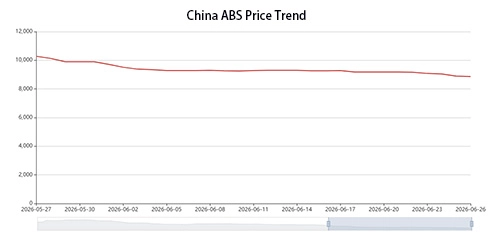
Regional Price Reference (June 2026)
| Region | Reference Price (USD/MT or Local Currency) | Notes |
| China (East China, General Injection Grade) | ¥8,900–10,450 /MT | Low-end materials broke 9K; intense market competition. |
| Southeast Asia (Imported General Grade) | USD 1,350–1,520 /MT CIF | Fluctuates following Northeast Asia and Chinese quotations. |
| Europe (General Injection ABS) | EUR 1,900–2,100 /MT FD | Supported by energy and logistics costs; decline smaller than in Asia. |
| North America (General Injection ABS) | USD 1,750–1,900 /MT DEL | Relatively stable; affected by local facility operating rates. |
Note: The above are typical price negotiation ranges for traders/distributors; specific grades (high gloss, flame retardant, plating grade) carry premiums; exchange rates are estimated based on the mid-market rate in June 2026.
Analysis of Core Price Drivers
- Raw Material Costs: Styrene accounts for approximately 40%–45% of ABS raw material costs, Acrylonitrile for 20%–25%, and Butadiene for 20%–25%. In June 2026, the retreat of crude oil from high levels and the weakening of pure benzene led to a wide downward adjustment in styrene. Butadiene also organized a downward trend due to weak demand for synthetic rubber. Together, these three factors significantly lowered the cost support level for ABS.
- Supply Side — Capacity Expansion and High Inventory Pressure: Domestic ABS industry capacity additions in 2026 primarily came from large-scale refining and chemical projects such as Zhejiang Petroleum & Chemical and PetroChina. The industry operating rate was maintained in the 55%–60% range, and social inventory was near a high level of 230,000 tons. High supply elasticity suppressed the scope for price rebounds.
- Demand Side — Traditional Off-season and Export Variables: June to July is the traditional off-season for the home appliance and electronic injection molding industry. Downstream factories mainly engaged in small-order restocking based on rigid demand, with a strong “wait-and-see” mentality. Regarding exports, after a 76% year-on-year increase in ABS exports from January to February 2026, the growth rate slowed, and demand in European and American markets remained suppressed by inflation and interest rate factors.
- Macroeconomics and Exchange Rates: Fluctuations in the RMB against the USD and changes in ocean freight costs affect the landed cost of imported and exported ABS, particularly impacting markets that rely on imported high-end grades (transparent ABS, high weather-resistant ABS).
Short-term Outlook (Early Q3 2026)
Currently, ABS producers are operating in a sustained low-margin or even loss-making range. Some facilities have appeared to implement temporary load reductions or unscheduled maintenance, providing a bottom support for prices. However, before demand substantially warms up in the early third quarter, the market will likely continue its weak, volatile pattern. Key variables to monitor include:
- Whether international crude oil and styrene can stabilize and rebound in the third quarter;
- The actual pulling effect of domestic “trade-in” policies on home appliance production in the second half of the year;
- Whether more production enterprises implement centralized production cuts due to inverted profits.
If large-scale production cuts occur alongside the start of peak-season stockpiling, a phased bottoming rebound may occur as early as mid-to-late August to September.
B2B Procurement Suggestions
- General Injection Grade (HI/GP ABS): Currently at a relative low for the year. It is advisable to moderately establish safety stocks combined with production plans, but staged position-building is recommended to avoid risks of creeping declines.
- Special Modified Grades (Flame Retardant/Plating/Transparent ABS): High-end grades are less affected by general material fluctuations. It is recommended to lock in prices according to fixed contract cycles, focusing on original manufacturer TDS and UL/RoHS compliance documents.
- Price-Locking Timing: Pay attention to styrene port inventory destocking signals and the adjustment trends of official ex-factory quotations from major petrochemical enterprises, which are usually among the signals for a short-term bottom.