In the daily operations of engineering plastic procurement and injection molding, selecting the right polycarbonate (PC) grade often comes with high trial-and-error costs. For an apparently general-purpose material, if the viscosity is mismatched or the drying process is inadequate, it can lead to silver streaks and bubbles in the finished product at best, or stress cracking resulting in entire batches being scrapped at worst. In Covestro’s extensive Makrolon® product portfolio, 2805 has become the best-selling general-purpose injection molding grade for the global electronics and automotive industries. This is no coincidence; it is due to the optimal balance it achieves between melt flowability and part toughness. This article breaks down the core technical parameters and processing pitfalls of 2805 from a practical perspective.
The Core Positioning of Makrolon® 2805: More Than Just “Medium Viscosity”
Makrolon® 2805 is a standard polycarbonate based on bisphenol A (BPA) with an MVR (melt volume-flow rate) of approximately 9 cm³/10 min (300°C/1.2 kg). This value makes it an ideal choice for the vast majority of structural parts with wall thicknesses in the 2-4 mm range.
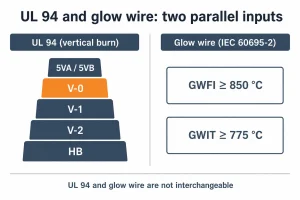
Compared to high-flow 2405 (MVR~19) and grades with lower flow and higher viscosity, 2805 offers a more forgiving processing window. It retains the signature high light transmission (88%) and excellent flame retardancy (UL 94 V-2) of PC materials, while possessing outstanding impact strength (Charpy notched impact strength of 70 kJ/m²), which is sufficient to meet the mechanical strength requirements of most consumer electronics housings and optical components.
Key Typical Technical Values
| Item | Typical Value | Unit | Test Standard |
| Density (23°C) | 1.2 | g/cm³ | ISO 1183 |
| Melt Volume-Flow Rate (MVR, 300°C/1.2kg) | 9 | cm³/10min | ISO 1133 |
| Tensile Modulus (23°C) | 2400 | MPa | ISO 527-2 |
| Tensile Strength (Yield) | 66 | MPa | ISO 527-2 |
| Charpy Notched Impact Strength (23°C) | 70 | kJ/m² | ISO 180/1A |
| Heat Deflection Temperature (1.8 MPa, Unannealed) | 125 | °C | ISO 75-2/A |
| Light Transmission (3 mm) | 88 | % | ISO 13468-2 |
| Flammability Rating (0.75 mm) | V-2 | — | UL 94 |
Guide to Avoiding Pitfalls: Processing Control for 2805
PC is notoriously “delicate,” and 2805 is no exception. For procurement professionals and process engineers, the following two points are crucial:
- Drying is the Bottom Line: 2805 is highly hygroscopic. If the moisture content exceeds 0.02%, silver streaks or even bubbles will occur during injection molding. It is recommended to dehumidify and dry at 120°C for 3–4 hours. Do not shorten the drying time to rush production, as the resulting defect rate will directly consume material costs.
- Mold Temperature Determines Internal Stress: To achieve high transparency and impact resistance, the mold temperature must be maintained between 80°C and 120°C. Low mold temperatures lead to the freezing of molecular chain orientation, creating internal stress that causes parts to fail during subsequent environmental stress cracking tests.
Cross-Reference: 2805 vs. 2405 vs. 2605
| Grade | MVR (cm³/10min) | Typical Application |
| Makrolon® 2405 | ~19 | High-flow expert: Suitable for thin-walled, long flow-path parts, such as mobile phone cases and precision connectors. |
| Makrolon® 2805 | ~9 | Universal powerhouse: Display housings, instrument panel covers, general structural parts. |
| Makrolon® 2605 | ~15 | Intermediate: Flowability between 2405 and 2805, balancing moldability and physical properties. |
Practical Analysis: Why Do Your 2805 Parts Crack? (Root Cause Analysis)
1. The Invisible Killer: Environmental Stress Cracking (ESC)
- Phenomenon: Parts crack suddenly after being stored for a few days after molding or after contact with chemical agents (e.g., alcohol, cleaning agents).
- Cause: Usually due to excessive internal stress or uneven molecular chain orientation. If the mold temperature is too low (<60°C) or the packing pressure is too high, the surface and core will shrink inconsistently.
- Countermeasure: Optimize mold temperature control and add an annealing process (120°C/1–2 hours) if necessary to release residual stress.
2. The Source of Optical Defects: Inadequate Drying
- Phenomenon: Transparent parts show silver streaks, bubbles, or increased haze.
- Cause: PC is extremely sensitive to moisture at high temperatures. Trace moisture gasifies in the high-temperature barrel, causing hydrolysis and breaking molecular chains. The high transparency of 2805 amplifies these defects.
- Countermeasure: Strictly execute the drying process, ensuring the hopper dryer temperature is stable at 120°C and the drying time is no less than 3 hours.
Industry Adaptation Guide: Process Focus for 2805 in Different Sectors
| Application Area | Core Concern | Process Adjustment Suggestion |
| Consumer Electronics Housings | Appearance & Dimensional Precision | Strictly control mold temperature uniformity to reduce shrink marks; monitor weld line position. |
| Automotive Interior Parts | Heat Resistance & Anti-Aging | Avoid prolonged high-temperature dwell times to prevent thermal degradation; note the thickness applicability of the V-2 flame retardancy rating. |
| LED Optical Lenses | Light Transmission & Haze | High cleanliness requirements to prevent dust contamination; mold temperature must be stable in the high range (100–120°C) to ensure surface gloss. |