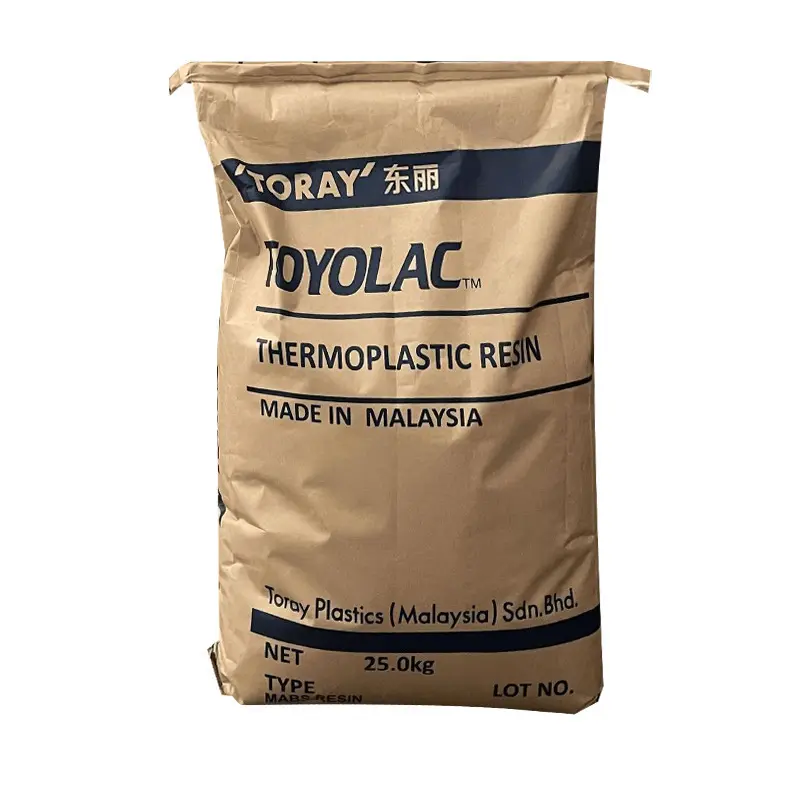
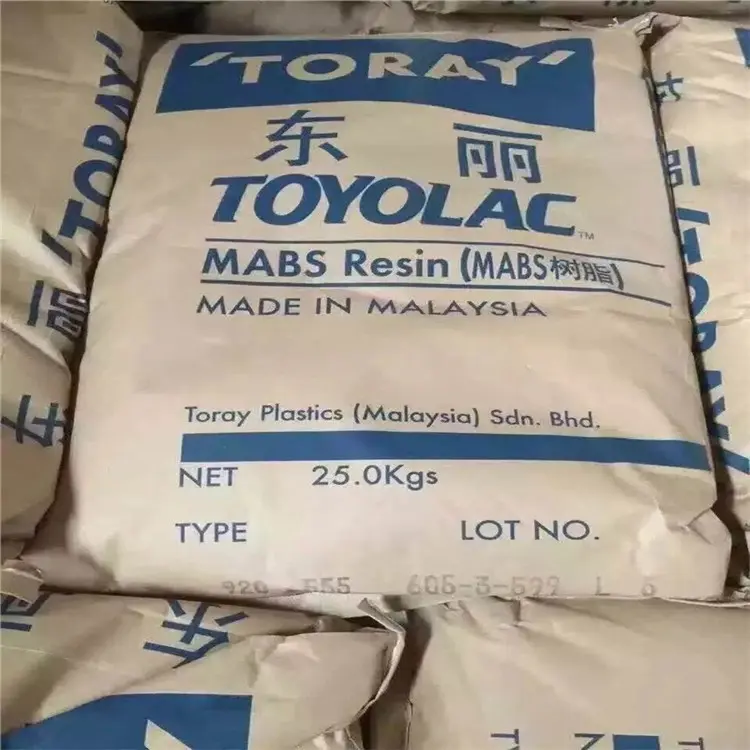
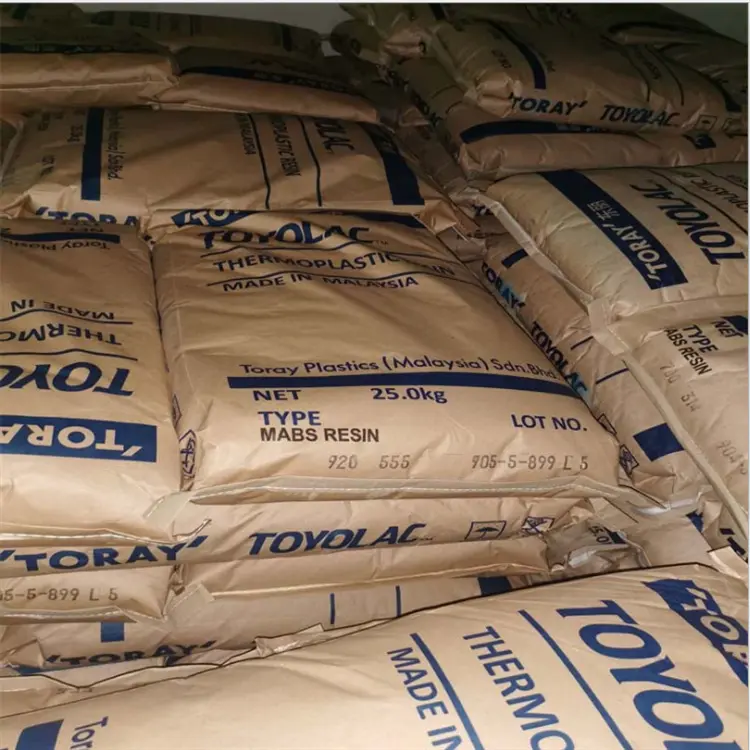
Toray Toyolac 920 555 U is a high-rigidity, transparent MABS polymer resin featuring balanced toughness, medium-high flowability, and a UL 94 HB rating, ideal for cosmetic packaging, electronics housings, and transparent industrial components.
| Manufacturer | Toray |
|---|---|
| Density | 1.08 g/cm³ |
| MFR | 19-23 g/10min |
| Tensile Strength at Yield | 490 kg/cm² |
| Flexural Modulus | 23500 kg/cm² |
Note: See the product description for additional technical specifications
Toray Toyolac® 920 555 U is a transparent MABS (Methyl Methacrylate-modified ABS) injection molding resin produced by Toray Plastics Malaysia Sdn. Bhd. (TPM), a subsidiary of Toray Industries, Inc., and belongs to the Toyolac® 920 transparent series. This material appears as water-clear cylindrical pellets. While maintaining the inherent rigidity and processing stability of ABS, it achieves high light transmittance (typical factory ISO transmittance of approx. 88%, haze approx. 2%) through the introduction of the MMA phase, making it a high-rigidity, medium-high fluidity, UL 94 HB general-purpose transparent MABS base grade.
Positioned in the Toyolac® transparent MABS matrix as a “high-rigidity + balanced toughness” general-purpose reference grade, 920 555 U features a Rockwell hardness of R115, a flexural modulus of 23500 kg/cm² (approx. 2300 MPa), an MFR of 19–23 g/10 min (220 °C/10 kg), and a heat deflection temperature of 89 °C (18.56 kg/cm², unannealed). It bridges the gap between GPPS (too brittle), PC (high cost, requires drying), and PMMA (low impact resistance, prone to stress cracking)—offering better toughness than PMMA, lower cost than PC, and higher strength and toughness than GPPS. It is a common material choice for cosmetic bottles, instrument panels, transparent home appliance parts, and OA equipment windows. Primarily intended for injection molding, this grade is not suitable for long-term outdoor unshielded exposure (as it lacks an anti-UV system).
| Physical Properties | Test Conditions | Property Value | Unit | Test Method |
| Viscosity | 220℃ plug-in viscometer | 3.5 to 5.0 | None | Internal Method |
| Water Absorption | Immersed in 23℃ water for 24 hours | 0.3 | % | ASTM D570 |
| Melt Flow Rate (MFR) | 220℃, 10kg | 19 to 23 | g/10min | ASTM D1238 |
| Density | Buoyancy method | 1.08 | g/cm³ | Internal Method |
| Mechanical Properties | Test Conditions | Property Value | Unit | Test Method |
| Tensile Yield Strength | 23℃ | 490 | kg/cm² | ASTM D638 |
| Rockwell Hardness | 23℃, R scale | 115 | None | ASTM D785 |
| Flexural Modulus | 23℃ | 23500 | kg/cm² | ASTM D790 |
| Yield Elongation | 23℃ | 3.5 | % | ASTM D638 |
| Tensile Breaking Strength | 23℃ | 380 | kg/cm² | ASTM D638 |
| Elongation at Break | 23℃ | 30 | % | ASTM D638 |
| Flexural Strength | 23℃ | 780 | kg/cm² | ASTM D790 |
| Thermal Properties | Test Conditions | Property Value | Unit | Test Method |
| Heat Deflection Temperature | 18.56kg/cm², unannealed | 89 | ℃ | ASTM D648 |
| Coefficient of Linear Thermal Expansion | — | 1.2×10^-4 | 1/℃ | ASTM D696 |
| Flame Retardancy | Test Conditions | Property Value | Unit | Test Method |
| Flame Retardant Rating | — | HB | None | UL 94 |
| Other Properties | Test Conditions | Property Value | Unit | Test Method |
| Izod Impact Strength | 12.7×12.7×62.5mm (notched), 23℃; 0℃; -30℃ | 9; 7; 6 | kg-cm/cm | ASTM D256 |
| Izod Impact Strength | 3.2×12.7×62.5mm (notched), 23℃; 0℃; -30℃ | 10; 7; 6 | kg-cm/cm | ASTM D256 |
The technical data sheet (TDS) of Toyolac® 920 555 U material from Toray corporation, if there are differences, please refer to the official website of Toray.
High Transparency and Low Haze Balance: MMA phase modification provides a clear aesthetic close to PMMA (typical factory ISO transmittance approx. 88%, haze approx. 2%) while retaining ABS base color stability, making it ideal for paint-free direct molding of transparent appearance parts.
High Rigidity & Dimensional Stability: Rockwell R115 hardness, flexural modulus of 23500 kg/cm² (approx. 2300 MPa), and low, uniform molding shrinkage (reference factory ASTM D955 typical value of 0.4–0.6%). Thin-wall transparent parts resist sagging or deformation, keeping assembly clearances controllable.
Medium-High Flowability & Wide Molding Window: MFR of 19–23 g/10 min (220 °C/10 kg) ensures smooth filling in complex thin-walled molds, with manageable weld lines and flow marks, making it suitable for high-volume injection molding of cosmetic bottles, instrument panels, and other appearance components.
Balanced Toughness and Rigidity: Notched Izod impact strength of 9 kg-cm/cm at 23 °C (12.7 mm thickness) outperforms GPPS and PMMA, resisting brittle cracking during room-temperature drops. However, it is lower than high-rubber ABS, so heavy-walled drop-impact applications require down-gauging evaluations.
Good Secondary Surface Processing: High-gloss surface provides stable adhesion for silk-screening, hot stamping, UV coating, and vacuum metallization, matching branding finish requirements.
Robust Electrical and Chemical Resistance: Stable under short-term contact with alcohols, mild detergents, and weak acids/alkalis; volume resistivity meets requirements for conventional low-voltage appliance transparent covers; UL 94 HB covers baseline flame-retardant needs for general electronics enclosures.
Cosmetics & Daily Chemicals: Perfume bottle caps, cream jars, cosmetic housings, transparent powder compacts, and transparent sections of toothbrush handles—leveraging high transparency, high gloss, and resistance to alcohol-based disinfecting wipes.
Consumer Electronics & OA Equipment: Printer/scanner transparent covers, router status windows, keyboard transparent keycaps, camera viewfinder covers, and instrument transparent viewing panels.
Home & Kitchen Appliances: Soymilk maker measuring cups, electric kettle water level windows, microwave door interior trims, small appliance transparent buttons, and refrigerator drawer trims.
Automotive Interiors: Instrument cluster transparent covers, air vent louvers, and interior reading light covers (non-exterior weathering parts, requiring shading or protective coatings).
Stationery & Toys: Transparent stationery shells, safety toy housings, model parts, and display props—RoHS/REACH compliance covers general toy export requirements.
Note: 920 555 U is a non-V-0 flame-retardant, non-anti-UV, and non-food-contact dedicated grade. Long-term outdoor exposure, contact with strong solvents, medical implants, or direct contact with pharmaceutical active ingredients are not recommended. Food contact applications must rely on original manufacturer FDA 21 CFR §177.1020 declarations and end-product testing.
Q1: Does 920 555 U require drying before processing? How should drying conditions be set?
A1: Yes. Although MABS absorbs less moisture than PA, its 0.3% water absorption can cause silver streaks, bubbles, and surface pitting at high melt temperatures. Hot-air dehumidifying drying at 75–80 °C for 3–4 hours is recommended, maintaining a moisture content of ≤ 0.1%. Transfer materials while sealed and insulated (60–70 °C) after drying to prevent re-absorption from ambient air. Barrel temperature should be set at 210–235 °C, mold temperature at 65–80 °C, and low-speed stable injection helps minimize weld lines.
Q2: How to choose between 920 555 U, PMMA, and PC for transparent parts?
A2: The three operate in different dimensions. PMMA offers higher transmittance (>92%) and harder surfaces but lower impact resistance and high susceptibility to stress cracking. PC provides extreme impact resistance and high heat resistance but carries a higher cost, requires strict drying, and is prone to yellowing. 920 555 U (MABS) sits in the middle—with ~88% transmittance, impact resistance superior to PMMA, lower cost than PC, and processing that does not require rigorous drying. It is ideal for daily chemical/electronic appearance parts requiring transparency, fracture resistance during drops, and cost control. Rule of thumb: choose PMMA for ultra-high transmittance, PC for high impact resistance and heat resistance, and MABS for balanced, general-purpose transparency.
Q3: What are the compliance and UL ratings for this grade?
A3: 920 555 U is provided with an original UL Yellow Card (HB rating, non-V-0), complies with RoHS and REACH restricted substance frameworks, and is accompanied by TDS, SDS, and COA per batch. It is not a halogen-free V-0 flame-retardant grade. If the end application strictly requires V-0 (such as charger enclosures or socket panels), you should switch to the Toyolac® flame-retardant series or use an alternative flame-retardant MABS. Medical or food-contact applications require a separate manufacturer declaration and final part testing.
Q4: What is the thinnest transparent wall achievable with an MFR of 19–23?
A4: Based on general Toray transparent MABS experience, 920 555 U can stably injection-mold transparent parts with wall thicknesses of 1.2–2.5 mm. For ultra-thin walls below 1.0 mm (such as thin packaging), it is recommended to raise the mold temperature to 75–80 °C, increase injection speed to fast, and evaluate weld line strength. If conventional parts have a wall thickness > 3.5 mm, this fluidity is relatively fast, requiring attention to packing/compensating shrinkage and sink mark control; switch to a lower MFR Toyolac® transparent grade if necessary.
Submit your inquiry today and receive a professional competitive price tailored to your project requirements.