What Is PC/ABS Plastic?
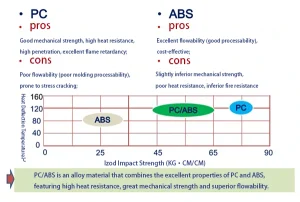
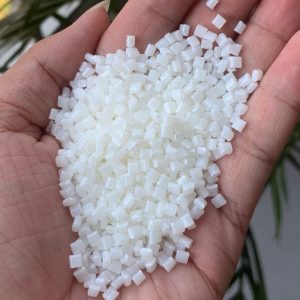
PC/ABS (also known as PC/ABS alloy or PC+ABS blend) is an engineering thermoplastic alloy produced by blending polycarbonate with ABS. The two materials complement each other:
- What PC brings: high strength, high impact resistance, excellent heat resistance (HDT of 110–120°C), and dimensional stability;
- What ABS brings: excellent flowability, good surface finish and paintability, at a significantly lower cost than pure PC.
By varying the blend ratio (typically 50–70% PC content), manufacturers can produce a series of grades — high-impact, high-heat, flame-retardant, glass-fiber reinforced, and more. The core value in one sentence: cheaper and easier to mold than pure PC; more heat-resistant and impact-resistant than pure ABS.
PC/ABS Properties: Why Engineers Choose It
| Property | PC/ABS Blend | Pure PC | Pure ABS |
|---|---|---|---|
| Heat deflection temperature (HDT) | Approx. 110–120°C | 125–135°C | 85–100°C |
| Notched impact strength | Medium-high (good low-temp impact) | High | Medium |
| Flowability | Good | Fair | Excellent |
| Dimensional stability | Excellent | Excellent | Good |
| Surface finish / paintability | Excellent (paintable/platable) | Good | Excellent |
| Material cost | Medium | High | Low |
| UV resistance | Poor (use ASA outdoors) | Poor | Poor |
Three reasons to choose it: ① Above 80°C continuous service temperature, pure ABS loses strength — PC/ABS handles it; ② lower shrinkage and better flow suit large thin-wall parts like dashboards and housings; ③ significantly lower material cost than pure PC.
Known limitations: PC/ABS has poor UV resistance — long-term outdoor exposure causes yellowing and embrittlement, so outdoor parts should use ASA; chemical resistance is also inferior to PC/PBT, so applications exposed to oils or solvents need careful evaluation.
PC/ABS vs ABS vs Polycarbonate: Which One to Choose?
| Your requirement | Recommended material | Why |
|---|---|---|
| High heat, high impact, thin-wall large parts | PC/ABS | Best balance of performance and cost |
| Budget-first, cosmetic parts, room temperature | ABS | Cheapest and easiest to process |
| Transparency, very high impact, long-term heat | Pure PC | Transparency and toughness are PC’s unique strengths |
| Chemical exposure, oil resistance, chassis parts | PC/PBT | Better chemical resistance than PC/ABS |
| Long-term outdoor, UV exposure | ASA / ASA-PC | PC strength + weather resistance |
Decision rule: room temperature and low cost → ABS; transparency or very high impact → PC; in between — needs heat resistance at a reasonable price → PC/ABS.
Key Applications of PC/ABS Resin
Automotive and electronics are the two main drivers, together accounting for roughly 70% of global demand.
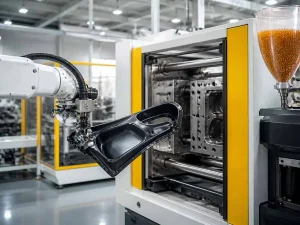
- Automotive interiors (~38%+): dashboards, center consoles, door panels, air vents. High heat resistance (in-cabin temperatures can exceed 90°C) and thin-wall molding capability make it the standard interior material, widely adopted by EV brands.
- Electronics housings (~29%): laptop shells, phone mid-frames, chargers, power tool housings. Flame-retardant PC/ABS (UL94 V-0) combines flame resistance, drop resistance, and surface quality.
- EV & new energy (fastest growing): EV charging connectors, charging station housings, battery pack connectors, high-voltage connectors — the most promising incremental market in 2026.
- Home appliances & medical: air conditioners, washing machines, vacuum cleaner housings; medical monitoring equipment and infusion pump housings (certified grades required).
Market share data source: Market Reports World, “PC/ABS Market Size, Growth Report 2034”.
PC/ABS Injection Molding: Parameters & Best Practices
The processing window is narrower than ABS but more forgiving than pure PC (general reference — always follow the specific grade’s TDS):
Drying (the most critical step): 80–90°C for 3–4 hours;
moisture content must be below 0.05% — excess moisture directly causes silver streaks, bubbles, and a sharp drop in mechanical properties.
| Parameter | Reference range |
|---|---|
| Barrel temperature (zones) | 220–260°C (rear 220–240°C, front 250–260°C) |
| Mold temperature | 60–80°C (higher mold temp improves surface quality and weld line strength) |
| Mold shrinkage | Approx. 0.4%–0.6%; watch warpage on large flat parts |
Common defects: silver streaks (insufficient drying), weak weld lines (mold temperature too low), flash (insufficient clamping force), gas marks (poor venting).
Popular PC/ABS Grades & How to Read a TDS
ZiJun Plastics (Jiangsu Zijun International Trade Co., Ltd.), an engineering plastic distributor with over 20 years of industry experience, keeps the following mainstream PC/ABS grades in stock:
- SABIC CYCOLOY™ C6600 PC/ABS: one of the most widely used general-purpose grades globally, with an excellent balance of flame retardancy and flow, widely used in electronics housings and automotive interior parts. View product details
- Formosa TAIRILOY® AC3100 PC/ABS: general-purpose grade with high impact and high heat resistance, ideal for automotive and appliance parts, with excellent batch-to-batch consistency. View product details
Read a TDS in 30 seconds: density (1.10–1.18 g/cm³, affects part weight and cost calculation) → melt flow rate / MFR (choose high MFR for large or thin-wall parts) → heat deflection temperature / HDT (match your service temperature) → Izod notched impact (a must-check for housings) → flame rating (UL94 V-0/V-2, the compliance gate for electronics).
Our commitment: every shipment comes with original TDS/MSDS and batch COA certification, free sample testing, custom modification (glass-fiber reinforcement, flame retardancy, color matching), and dedicated engineers for material selection and molding parameter support.
PC/ABS Resin Price & Buying Guide (2026)
Price drivers: ① Feedstock chain — upstream bisphenol A (BPA) for PC and styrene/butadiene for ABS pass directly into PC/ABS alloy pricing; ② supply and demand — strong automotive and EV demand, with high-end flame-retardant/high-heat grades concentrated among major producers (SABIC, Formosa, etc.); ③ grade differences — general-purpose vs flame-retardant grades can differ by 20–40%; ④ trade and FX — freight, tariffs, and exchange rates affect CIF quotes.
Buying checklist:
- Request original TDS/MSDS/COA and verify grade and lot consistency;
- Ask for sample testing — run a small trial molding first to verify batch stability;
- Confirm MOQ and lead time (standard MOQ for engineering plastics starts around 1 ton; trial orders accepted);
- Clarify trade terms (FOB/CIF/CFR) and moisture-proof packaging.
FAQ
Q1: What is the melting point of PC/ABS?
A: As an amorphous alloy it has no fixed melting point; the recommended melt temperature is 220–260°C, with an HDT of around 110–120°C.
Q2: Is PC/ABS food safe?
A: It depends on the grade certification. Some medical/food-contact grades are FDA or NSF certified, while general-purpose grades are not — specify certified grades when ordering.
Q3: Can PC/ABS be used outdoors?
A: Not recommended for long-term outdoor use — poor UV resistance causes yellowing and embrittlement. Choose ASA or ASA/PC for outdoor applications.
Q4: PC/ABS or PC/PBT for automotive interiors?
A: PC/ABS offers better value for interior parts (dashboards, consoles); choose PC/PBT for parts exposed to oil or requiring chemical resistance.
Conclusion
PC/ABS is one of the engineering plastics with the best balance of performance, cost, and processability — which is exactly why it remains a mainstay in the automotive and electronics industries. In 2026, demand continues to grow steadily with rising EV penetration and thinner, lighter electronics.
Whether you are a molder in material selection or a buyer in need of a reliable supply source, contact ZiJun Plastics (Jiangsu Zijun International Trade Co., Ltd.) — over 20 years of plastic resin export experience, serving 30+ countries worldwide, with original TDS/MSDS compliance and traceable batches.