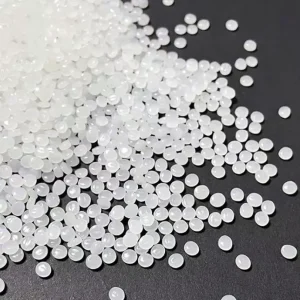
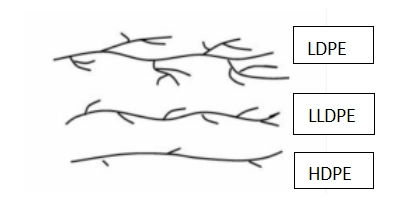
Linear Low Density Polyethylene (LLDPE) is structurally a thermoplastic polymer synthesized through the copolymerization of ethylene with small amounts of higher alpha-olefins (such as 1-butene, 1-hexene, or 1-octene) in the presence of a catalyst. Compared to traditional Low Density Polyethylene (LDPE), LLDPE does not contain long-chain branching but instead exhibits a linear backbone with numerous uniform short-chain branches. This unique microscopic molecular topology endows it with distinct physical and chemical properties that lie between High Density Polyethylene (HDPE) and Low Density Polyethylene (LDPE).
The core physical properties of LLDPE are analyzed below across dimensions including molecular structure mechanisms, mechanical behavior, thermal and processing characteristics, and chemical barrier resistance:
Density and Crystallinity Mechanism
The density of LLDPE at room temperature is typically tightly controlled between 0.915 – 0.930 g/cm3, classifying it as a semi-crystalline macromolecular material.
- Regulatory Effect of Short-Chain Branching: The short-chain branches (derived from comonomers) on the molecular backbone of LLDPE effectively hinder the regular arrangement of polymer chains, thereby restricting the perfect growth of crystalline regions. The introduction amount and branch length of the comonomer directly determine the density and crystallinity of the final resin.
- Crystallinity Performance: Its crystallinity generally remains between 35% and 60%. Compared to LDPE, where long-chain branches are entangled with each other, LLDPE possesses a higher narrow lamellar thickness distribution, which allows it to maintain the flexibility of low density while providing significantly superior rigidity and tensile yield strength over LDPE.
Mechanical Performance Profile
The unique linear topological structure of the molecular chains and the high density of short-chain branches enable LLDPE to exhibit extreme toughness when subjected to external deformation:
- Top-Tier Puncture and Tear Resistance: The entanglement network between LLDPE molecular chains allocates and transfers stress more efficiently when punctured by sharp objects. Its tear strength in the machine direction (MD) and transverse direction (TD) is highly balanced. Especially in grades using 1-hexene or 1-octene as the comonomer, its puncture resistance indicators significantly surpass traditional LDPE, making it the core material for down-gauging film designs.
- Excellent Tensile Properties: The elongation at break of LLDPE can typically reach 500% to 800% or more. During the stretching process, the linear chain segments undergo significant orientation hardening, thereby providing extremely high tensile strength at break.
- Outstanding Environmental Stress Cracking Resistance (ESCR):Environmental stress cracking is a common brittle failure in polyethylene under the combined action of surfactants and mechanical stress. The linear backbone and uniform short-chain branches of LLDPE effectively prevent the initiation and propagation of microcracks, and its ESCR lifespan (often exceeding hundreds or even thousands of hours) is much higher than that of LDPE.
Thermal and Rheological Behavior
The thermal characteristics of LLDPE are closely related to its microscopic crystal structure, which directly determines its downstream processing window:
- Higher Melting Point Range: The melting point of LLDPE is typically between 120 °C and 125 °C, which is significantly higher than that of traditional LDPE (typically 105 °C – 115 °C). This means that LLDPE products possess a higher heat deflection temperature, allowing them to maintain structural stability in higher temperature environments.
- Insignificant Shear Thinning and High Extensional Viscosity: In the molten processing state, because LLDPE lacks long-chain branching, its macromolecular chains do not easily slide past each other when subjected to high shear forces, meaning its shear thinning effect is markedly weaker than that of LDPE. At the same shear rate, the apparent viscosity of LLDPE melt is higher, resulting in higher screw backpressure in the extruder and increased motor load. However, it possesses an extremely high extensional viscosity, which gives it excellent melt extensibility during the film blowing process, making it less prone to melt fracture.
Chemical and Optical Properties
- Chemical Inertness: As a non-polar, saturated hydrocarbon polymer, LLDPE possesses natural resistance to most chemicals. It is insoluble in any known solvent at room temperature and exhibits excellent stability against non-oxidizing acids, alkalis, aqueous salt solutions, as well as alcohols, aldehydes, and ketones. However, it will undergo a certain degree of swelling during prolonged contact with aliphatic, aromatic hydrocarbons, or halogenated hydrocarbons.
- Optical Clarity Balance: Because the internal crystal size and spherulite distribution of LLDPE are denser relative to LDPE, the haze of its film is typically slightly higher than that of LDPE, and its transparency is slightly inferior. In actual industrial production, its optical clarity is usually optimized by blending it with high-transparency LDPE or adding highly efficient nucleating agents.
- Moisture Barrier Performance: Due to its relatively higher crystallinity compared to LDPE, LLDPE exhibits superior moisture barrier properties (extremely low moisture vapor transmission rate, MVTR), effectively preventing internal moisture loss or external moisture intrusion, though its barrier property against non-polar gases like oxygen and carbon dioxide is weak.
Downstream Property Evolution
The aforementioned physical properties of LLDPE directly determine its mainstream application directions in the global resin trade:
- Blown and Cast Films: Utilizing its extreme puncture resistance, tear resistance, and low-temperature flexibility, it is commonly used to manufacture heavy-duty shipping sacks, stretch film, agricultural mulch film, composite film tie layers, and food cling wrap.
- Rotomolding and Injection Molding: Leveraging its excellent environmental stress cracking resistance (ESCR) and toughness, LLDPE with a medium-to-high melt flow index (MFI) is widely used in rotational molding to manufacture large outdoor water storage tanks, chemical containers, pipes, and amusement facilities, as well as in injection molding for daily plastic products and durable containers.