In the field of high-performance polypropylene (PP) modification, achieving the optimal balance between toughness and processing fluidity remains a critical challenge. As a representative grade with a density of 0.880 g/cm³ and a melt flow rate (MFR) of 3.0 g/10min, SK POE 883 acts as more than a simple filler within a modified system. It forms specific micro-phases through complex molecular chain entanglements, which ultimately dictate the impact resistance of the final product.
The Equilibrium Between Octene Content and Molecular Chain Flexibility
As a characteristic ethylene-octene copolymer, the core performance of SK POE 883 is derived from its specific octene monomer percentage.
The introduction of octene branches disrupts the crystallinity of the ethylene chains, creating extensive amorphous regions at the microscopic level. This structural configuration grants the material an exceptionally low glass transition temperature (Tg). In practical applications, this ensures that even when ambient temperatures drop to -30°C or lower, the molecular chains of SK POE 883 retain sufficient mobility to absorb external impact energy through deformation—forming the foundation of its role as a high-performance impact modifier.
Evolution of the “Sea-Island” Structure: Why an MFR of 3.0 is Critical
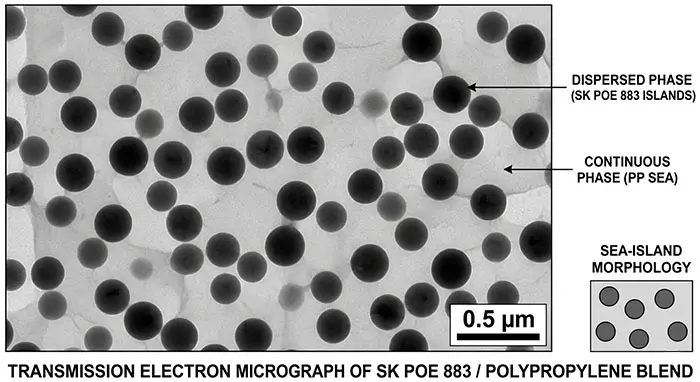
When blending SK POE 883 with polypropylene, the melt flow rate directly determines the particle size distribution of the dispersed phase (POE) within the continuous phase (PP).
- Viscosity Matching and Shear Force: SK POE 883 possesses a medium melt index of 3.0. Under the shear forces of injection molding, this viscosity level allows for superior matching with most automotive or appliance-grade polypropylene substrates.
- Particle Size Distribution: If an elastomer’s melt index is too high, it tends to form a lamellar distribution during blending; if it is too low, the particles become difficult to break down. SK POE 883 facilitates a uniform “island” distribution within the matrix. Reaching an ideal rubber phase particle size—typically between 0.1 and 0.5 microns—is essential for triggering the “crazing-shear banding” theory.
Stress Concentration and Shear Yielding Mechanisms
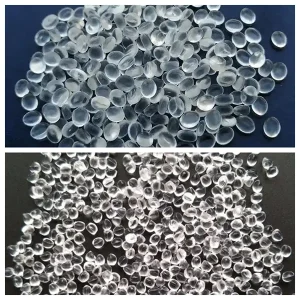
When the modified polypropylene is subjected to external impact, the POE particles—transformed from their original pellet form—act as points of stress concentration.
- Crazing Induction: The POE particles induce the generation of numerous microscopic crazes, which consume energy.
- Crazing Termination: Thanks to the inherent flexibility and toughness of SK POE 883, it effectively prevents these crazes from propagating into destructive cracks.
- Matrix Shear Yielding: This uniform particle distribution encourages large-scale shear yielding of the polypropylene matrix, converting instantaneous impact energy into dissipated thermal energy. This explains why automotive bumpers modified with this grade exhibit such exceptional structural integrity during low-temperature collisions.
Comparative Analysis: Optimizing Cost and Performance with SK 883
In the practical selection of materials for polymer modification, engineers often decide between SK POE 883 and comparable products from Dow. Both are highly similar in terms of density and melt flow rate, positioning them as strong equivalent materials.
However, the specific catalytic fine-tuning utilized by SK Geo Centric allows the 883 grade to demonstrate a wider processing window and superior surface gloss when blended with certain domestic or recycled polypropylene resins. This provides a distinct competitive advantage in the production of household appliance housings where aesthetic requirements are stringent.
Conclusion
The value of SK POE 883 lies not in any single physical property, but in the precise coupling of its density and flowability, which ensures microstructural stability. For compounding plants pursuing advanced polymer solutions, a deep understanding of phase morphology evolution during melt blending is the key to fully unlocking the polypropylene toughening potential of this material.