Polyethylene terephthalate, abbreviated PET, is the raw material behind water bottles, fresh-food trays and the polyester in clothing. Most PET produced worldwide ends up as fiber; bottles come second. It is also one of the most thoroughly recycled plastics, and the number 1 inside the triangle on the base of a bottle refers to it.
What PET Is
PET is made by polycondensing two raw materials: terephthalic acid and monoethylene glycol. The first comes from petroleum refining, the second is one of the most common diols. The two monomers alternate along a long molecular chain, and the length of that chain determines what the material can ultimately be made into.
PET is easily mistaken for a single fixed product. It is in fact a family: the same polymer, built to different chain lengths and crystallized to different degrees, yields four commercial grades that are not interchangeable.
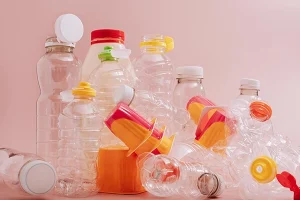
- Bottle grade: longer chains provide enough melt strength to blow a preform, with the best clarity and gas barrier.
- Fiber grade: shorter chains allow drawing into very fine filaments, which is the polyester most people know from clothing.
- Film grade: requires uniform thickness and freedom from gel particles, for packaging and insulating films.
- Engineering grade: higher molecular weight or glass-fiber reinforcement, for load-bearing structural parts.
These four cannot be swapped. Blow a bottle from fiber grade and the wall thickness will not distribute evenly. Spin fiber from bottle grade and the draw line breaks constantly. When a supplier says “PET”, the first question is which grade.
The material ships as pellets, usually transparent or milky white, cylindrical or lenticular in shape. Dry pellets are stable. Once they absorb moisture, high-temperature processing causes hydrolysis, a consequence of the polyester structure discussed below.
What PET Does Well
Clear, light and strong. A PET bottle matches the clarity of glass at under one-tenth the weight of a glass bottle of the same volume, and it does not shatter into sharp fragments when dropped. At equal wall thickness it is stronger than most commodity plastics, which is why the body of a 500 ml water bottle can weigh well under 20 g.
A good gas barrier. This point is often overlooked, yet it is the reason PET took hold in beverages. Carbon dioxide escapes through a plastic wall over time, and a soft drink that has lost its gas is simply sweet water. PET blocks CO₂ noticeably better than polypropylene or polyethylene, so that combined with a sealed closure, a shelf life of several months becomes achievable.
One material, two states. Cool PET melt quickly and the chains do not have time to organize, leaving an amorphous, transparent solid. That is how a water bottle is formed. Cool it slowly, or add a nucleating agent, and the chains arrange into crystalline regions: the material turns white, hardens, and gains a large increase in heat resistance. This is the crystallized PET used for oven-safe CPET trays, the same polymer as a clear bottle.
Three limitations are worth stating plainly. Heat resistance is limited, with softening beginning in the low 70s °C, so a bottle filled with boiling water will shrink and deform. Strong alkalis attack it, and prolonged contact causes hydrolysis and embrittlement. Surface hardness is modest, so repeated abrasion produces a hazy, scuffed appearance. Knowing these three points is enough to avoid putting the material where it does not belong.
| Material | Clarity | Heat resistance | Impact | Resin code |
|---|---|---|---|---|
| PET | High | Softens from about 70 °C | Good, does not shatter | 1 |
| PP | Medium to high | Boiling water, microwave safe | Good | 5 |
| PC | High | About 120 °C | Very good | 7 |
| Glass | Highest | Very high | Brittle | Re-meltable |
Where PET Is Used
Beverage packaging. Bottled water, carbonated soft drinks, juices, tea drinks and edible oil. This is the most familiar outlet and the main destination for bottle-grade PET. Requirements differ sharply within the category: carbonated drinks must withstand internal pressure, juices need oxygen barrier, and hot-fill drinks must tolerate elevated temperatures, which is why bottle grade is further subdivided by application.
Food packaging. Fresh-food trays, vacuum bags, retort pouches and twist-wrap film for confectionery. These are typically made from sheet by thermoforming, or from film-grade pellets. CPET trays form a distinct branch, with a crystallinity high enough to survive oven temperatures, common in airline catering and ready-meal packaging.
Fiber. Apparel, home textiles, carpets and nonwovens. The largest share of PET by volume actually sits here rather than in bottles. Quick-dry sportswear, down-jacket shells, curtains and automotive interior fabrics are mostly polyester. Converting recycled bottle flake into fiber is the single biggest outlet for rPET.
Engineering plastics. Automotive components, electrical and appliance structural parts, connectors and bobbins. These usually call for glass-fiber reinforcement, or for PBT, a close polyester relative that crystallizes faster and shortens cycle time.
Sheet and specialty. Capacitor film, insulating film, X-ray film base and solar backsheet film. PETG deserves a separate mention: a third monomer is added during polymerization, making it easier to process and tougher, which is why it appears in medical device packaging and 3D printing filament. Strictly speaking, it is no longer plain PET.
Is PET Safe?
The finished material is not toxic and is cleared for food contact. The polymer chain is stable at room temperature, does not volatilize and does not dissolve in water, and it has no known acute or chronic toxicity. Hundreds of millions of beverage bottles are used every day, a volume that is itself indirect evidence of long-term safety.
It contains no bisphenol A. This deserves a direct statement, because the two are frequently confused online. Bisphenol A is a raw material for polycarbonate (PC), and PET synthesis does not use it at all. Treating every clear plastic as a bisphenol A risk conflates two different materials.
Antimony residue is a question of limits. Antimony-based catalysts are widely used in polycondensation, leaving trace antimony in the finished resin. Food-contact regulations in major markets set explicit migration limits for antimony, and compliant products do not exceed them under normal use. Higher temperatures and longer contact times increase migration, which is one more reason PET is unsuitable for boiling water, separate from the deformation issue.
Acetaldehyde is a taste problem, not a safety problem. When processing temperatures run too high or residence time too long, PET degrades slightly and releases trace acetaldehyde, which gives water a faintly sweet, off note. This is controlled through drying, lower melt temperature and shorter residence time. It has nothing to do with toxicity.
Respect the heat limit. Ordinary PET bottles should not hold boiling water and should not go into a microwave. CPET trays are crystalline and can go into an oven, but the two must not be confused, since a standard water bottle will simply deform in a microwave.
Food-contact claims rest on compliance documents. For the United States, look for the FDA food-contact notification; for the European Union, EU 10/2011 and its amendments; for China, the GB 4806 series. These are declarations tied to a specific grade, not general conclusions about a material category.
Single-use bottles are not intended for long-term reuse. The reason is not leaching but microbial growth around the neck and finish, plus stress whitening and microcracks from repeated squeezing. Refilling with cool water a few times is unproblematic; keeping one as a permanent flask serves no purpose.
Can PET Be Recycled?
Yes, and it is one of the most established streams. The number 1 inside the triangle on the base is PET’s resin identification code. A well-defined melting point, stable melt viscosity and a density that separates cleanly from other plastics make sorting and re-pelletizing comparatively straightforward.
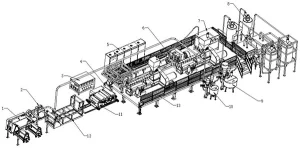
Mechanical recycling is the main route. Collected bottles are sorted, decontaminated, shredded and washed, freed of labels and caps, then melted and pelletized into recycled pellets, known as rPET. Cleaning is the critical step: residual adhesive, oil and label fragments directly affect the color and odor of the recycled material.
Food-grade rPET carries an extra requirement. For recycled material to return to food packaging, the recycling process itself must be assessed and shown to remove contaminants effectively. In the United States this runs through the FDA’s No Objection Letter mechanism; in Europe, through an EFSA safety assessment. Recyclate without either clearance is confined to fiber, sheet and non-food applications and cannot go directly into beverage bottles.
Where rPET goes. Some returns to bottles, the so-called bottle-to-bottle loop. The largest volume becomes fiber, and a further share goes into sheet and strapping.
Chemical recycling is advancing. The approach depolymerizes PET back to its monomers and re-polymerizes them into resin of virgin quality. Glycolysis and methanolysis are the common routes. It can handle low-quality waste that mechanical recycling struggles with, but cost and energy consumption remain higher, and commercialization is still in progress.
The practical limits deserve mention. Colored bottles, multilayer structures, full-body sleeves and stubborn adhesives all reduce recovery value. Clear, mono-material bottles with easily removed labels are what the recycling system actually wants.
Conclusion
PET is one material wearing four identities. Bottles, clothing, trays and connectors share the same chemistry yet perform very differently. What separates them is not a secret formulation but chain length and crystalline state.
Judging whether a PET article suits an application follows a fixed order: establish which grade it belongs to, examine the performance envelope of that grade, and only then discuss specific figures. Reversing the order is how a handsome data sheet ends up producing a product that should never have been made.