Introduction to Polyolefin Elastomers
Polyolefin elastomers (POE) are a class of materials synthesized by copolymerizing ethylene with α-olefins using metallocene catalysts. The molecular chain is saturated and lacks polar groups, providing weatherability and chemical stability comparable to standard polyolefins; meanwhile, the comonomers disrupt the polyethylene crystallization sequence, softening the material and delivering excellent resilience.
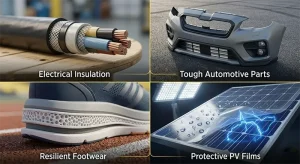
These materials first entered industrial prominence to resolve the issue of polypropylene (PP) being prone to brittle fracture under low-temperature and notched impact conditions. Today, their applications extend far beyond plastic modification, encompassing photovoltaic encapsulant films, wire and cable jacketing, soft-touch molded parts, and high-toughness packaging films.
PP and PE Impact Modification (Largest Consumption Volume)
The primary limitations of polypropylene (PP) are poor low-temperature toughness and notched sensitivity. Homopolymer PP suffers a sharp drop in impact strength near 0 °C as molecular chain motion freezes, causing molded parts with sharp corners or weld lines to crack easily. Adding elastomers is currently the most direct and efficient modification strategy.
Primary Application Scenarios:
- Automotive Industry: Bumpers, instrument panel skeletons, door panels, and wheel flares (commonly known as TPO modified plastics).
- Home Appliances & Industrial Parts: Washing machine inner tubs, battery housings, toolboxes, and turnover crates (relying on elastomers for drop impact resistance).
- Packaging Films: Toughness layers in heavy-duty shipping sacks, stretch films, and laminated films.
Toughening Mechanism & Grade Selection:
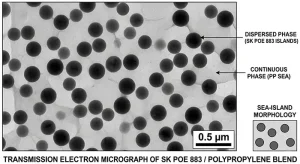
Elastomer particles dispersed within the matrix absorb and dissipate impact energy, arresting crack propagation. Particle size and interfacial bonding are decisive factors; higher loading levels do not inherently yield better performance. Grade selection focuses on density (crystallinity/hardness baseline), octene content (low-temperature ductility), and MFR (dispersion efficiency and processing window). It must be emphasized that toughening comes at the expense of flexural modulus and heat resistance, placing an upper boundary on loading levels.
Photovoltaic Encapsulant Films (High-Growth Sector)
In photovoltaic modules, encapsulant films are laminated between glass and solar cells to provide adhesion, cushioning, electrical insulation, and moisture ingress protection. Performance evaluation prioritizes optical transmittance, weatherability, and long-term electrical insulation.
- Core Advantages: POE exhibits a significantly higher volume resistivity and lower water vapor transmission rate (WVTR) than EVA, offering superior mitigation against Potential-Induced Degradation (PID). During lamination and long-term service, it releases no acetic acid, eliminating corrosion risks for glass coatings and solar cell grid lines while providing excellent resistance to yellowing.
- Industry Trends: N-type cells (TOPCon / HJT) are heightened in sensitivity to PID, combined with glass-glass modules eliminating the moisture barrier of traditional backsheets, accelerating the market transition toward POE encapsulants and co-extruded structures.
- Selection Boundaries: Key metrics include MFR, volume resistivity, crosslinking degree, and peel strength. General-purpose injection-grade POE must never be repurposed for encapsulant film production, as it leads to lamination bubbles, insufficient crosslinking, or substandard peel strength.
Wire & Cable and TPE/TPV Compounding
- Wire and Cable: Serves as a primary domain for low-smoke halogen-free (LSHF) flame-retardant jacketing. The saturated backbone of POE delivers weatherability and thermal-oxidative aging resistance, accommodating high loadings of aluminum hydroxide (ATH) or magnesium hydroxide (MDH) without severe embrittlement; it contains no halogens and releases no corrosive gases during combustion.
- TPE / TPV Compounding: POE exhibits good compatibility with PP and PE without requiring added compatibilizers. It is widely used as a base polymer or modifier in door/window weatherstripping, tool handle overmoldings, and soft-touch injection parts. High-Mooney viscosity grades are better suited for high-filler compounding.
Other Application Sectors
- Packaging Films: Utilizes its low seal-initiation temperature and soft texture for heat-sealable and puncture-resistant layers (ideal for high-speed packaging lines and cold-chain logistics).
- Construction & Waterproofing: Applied in TPO waterproofing membranes and roofing sheets to meet UV resistance, thermal cycling, and hot-air welding requirements.
- Footwear & Medical: Used in foamed midsoles (prioritizing resilience and low compression set), elastic nonwovens, and medical breathable films.
Grade Selection Guide by Application
| Application | Priority Parameters | Primary Processing Method |
| Automotive TPO Modification | Octene Content > Density > Melt Flow Rate (MFR) | Twin-screw Compounding + Injection Molding |
| PV Encapsulant Film | Melt Flow Rate (MFR) > Volume Resistivity > Density | Cast Film / Extrusion |
| Halogen-Free Cable Jacketing | Mooney Viscosity > Filler Capacity > Melt Flow Rate | Compounding + Extrusion |
| TPE / TPV Compounding | Mooney Viscosity > Density > Melt Flow Rate | Twin-screw or Internal Mixing + Injection Molding |
| Film Heat-Seal Layer | Melt Flow Rate (MFR) > Density > Octene Content | Blown Film / Cast Film |
Four Common Misapplication Pitfalls:
- Direct Toughening of PA/ABS: Incompatible polarity prevents interfacial bonding; grafted POE must be used instead.
- Extruding High-MFR Grades: Causes melt sag and severe dimensional instability.
- Using Injection Grades for PV Encapsulants: Mismatched crosslinking systems and additive packages lead to lamination defects.
- Compounding into Sulfur Vulcanization Systems: POE lacks unsaturated double bonds and cannot crosslink in traditional sulfur systems (requiring peroxide or silane crosslinking).
Conclusion
The diverse industrial applications of POE originate from three core attributes: its saturated backbone (weatherability and chemical resistance), comonomer incorporation (flexibility and low-temperature ductility), and thermoplastic nature (ease of processing and recyclability). The correct selection methodology remains: Define the Application → Match the Processing Method → Compare Specific Metric Parameters.