What is POE?
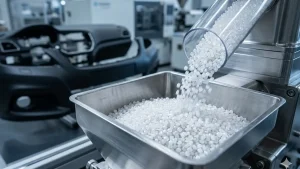
Polyolefin Elastomers (POE) are thermoplastic elastomers produced by the metallocene-catalyzed copolymerization of ethylene with alpha-olefins (such as 1-butene, 1-hexene, or 1-octene) as raw materials.
Structure and Performance Mechanism
- Unique Molecular Structure: The metallocene catalyst system imparts a narrow molecular weight distribution and a uniform short-chain branching structure to POE.
- Combining Dual Characteristics: The polyethylene crystalline regions act as physical crosslink points, providing the processability and thermoplasticity of plastics. Meanwhile, the introduction of alpha-olefins (such as octene) weakens crystallinity, giving it high resilience and elastomeric flexibility similar to rubber. Due to its fully saturated molecular main chain containing no double bonds, it exhibits exceptional aging resistance.
Typical Physical Properties
| Performance Indicator | Typical Range | Description |
| Density | 0.85-0.89 g/cm3 | Lower than EPDM and EVA, favoring lightweighting of end-products |
| Elongation at Break | >= 600% | Excellent tensile and rebound elastomeric performance |
| Hardness | 60-90 Shore A | Wide hardness span, covering the range from highly flexible to semi-rigid |
| Glass Transition Temperature (Tg) | -50 to -60 degrees C | Some special grades can reach as low as -76 degrees C |
| Vicat Softening Point | 60-90 degrees C | Can well adapt to conventional thermoplastic processing technologies |
The Four Core Characteristics of POE
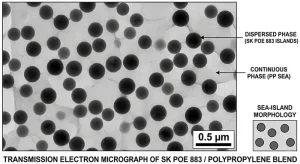
- Excellent Low-Temperature Impact Resistance The introduction of octene and other co-monomers into the molecular chain enhances its flexibility, bringing the brittleness temperature as low as -76 degrees C (superior to EPDM’s -50 degrees C). It maintains outstanding toughness in extremely cold environments. Added as a toughener to PP or PE, it significantly improves the materials’ notched impact strength at room and low temperatures.
- Outstanding Weatherability and Aging Resistance The saturated molecular chain structure does not contain vulnerable unsaturated double bonds, making it highly resistant to ozone, ultraviolet (UV) light, and thermal-oxidative aging.
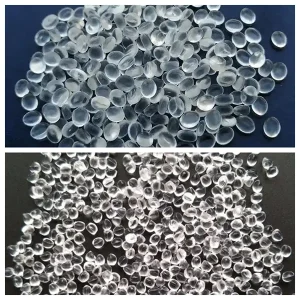
- Excellent Processing Convenience and Compatibility It has excellent compatibility with polyolefin materials such as PP and PE. POE comes in granular form, which is easy for bulk conveying and metering. It requires no traditional rubber vulcanization (crosslinking) process and can be directly processed by thermoplastic processing methods like injection molding, extrusion, and blow molding, with the scrap recyclable.
- Low Density and Lightweighting Advantage Its density is significantly lower than that of traditional elastomers like EPDM and EVA. The introduction of POE-modified polypropylene in automotive components is a key route to achieving weight reduction in plastic parts and lower energy consumption in new energy vehicles.
Major Application Fields
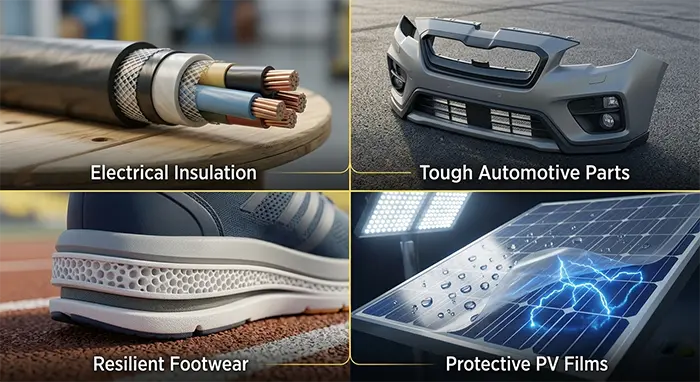
- Automotive Industry (The largest consumption sector): As an impact modifier for PP, it is widely used in automotive bumpers, dashboards, door panels, airbag covers, etc., and is gradually replacing traditional EPDM solutions. It is also used in TPO waterproofing membranes and automotive eco-friendly interior leather.
- Photovoltaic Encapsulation Films (A high-growth sector): POE encapsulation film has a very low water vapor transmission rate (roughly one-seventh of EVA’s), high volume resistivity, and excellent anti-PID (potential-induced degradation) performance. It is an indispensable encapsulation material for N-type double-glass solar modules.
- Wire and Cable: Used as a base material in low-smoke halogen-free flame retardant (LSZH) cable compounds to replace PVC, giving cables excellent flexibility, insulation, and weather resistance.
- Plastics Modification and Compatibilizers: Used for the toughening modification of engineering plastics such as PA, PBT, and PET after maleic anhydride grafting (POE-g-MAH), or as a compatibilizer for different polymer alloys.
- Packaging Film and Footwear: Leverages its high transmittance and excellent puncture resistance for food and medical packaging; in footwear, blend it with EVA to significantly improve the resilience and compression permanent deformation performance of athletic shoe midsoles.
Overview of Major Global Manufacturers and Suppliers
Major International Manufacturers
| Manufacturer | Brand / Series | Region | Positioning and Features |
| Dow (USA) | ENGAGE | USA | The earliest commercializer and market pioneer with the most complete grade line, covering all fields such as PV, automotive, and cable. |
| Mitsui Chemicals (Japan) | TAFMER | Japan | Has clear advantages in high-end PV encapsulation and flexible packaging applications. |
| LG Chem (Korea) | LC Series | Korea | General-purpose and modified grade POE with high cost-performance ratio, strong competitiveness in automotive and electronic modification markets. |
| ExxonMobil (USA) | Exact, Vistamaxx | USA | Focuses on high-elasticity flexible packaging, stretch films, and special modification applications. |
| SABIC / SSNC | FORTIFY | Saudi Arabia/Korea | High-quality ethylene-octene copolymer, mainly targeting the modification and packaging markets. |
Major Chinese Suppliers (The Fast-Growing Supply Force)
China’s POE industry has achieved critical breakthroughs. By 2025/2026, the total POE plant capacity in China has exceeded 700,000 tons, with a significantly improved self-sufficiency rate, rapidly penetrating the mainstream markets of PV and automotive modification.
| Enterprise | Capacity / Progress | Technical Features and Applications |
| Wanhua Chemical | Phase I 200,000 t/a commissionedPhase II 400,000 t/a under construction | Integrates self-produced alpha-olefin feedstock, product purity reaches 99.5%, directly supplies to top PV film companies like First and Swick. |
| PetroChina (Dushanzi Petrochemical) | Currently nearly 60,000 t/aTo exceed 300,000 t/a by the end of 2026 | China’s first gas-phase polymerization process, no solvent emissions, reducing overall energy consumption by 40%. The main grade UL0588 transmittance reaches international advanced levels. |
| Shenghong Petrochemical | 100,000 t/a commercialized | Successfully developed 18 grades, comprehensively covering PV and automotive modification grade fields. |
| Hainan Bio-one | Currently about 30,000 t/a100,000 t/a new plant commissioned recently | The first pioneer enterprise in China to achieve POE localized substitution and commercial production. |
| Dingjide | Phase I 200,000 t/a under construction | Plant construction focuses specifically on high-barrier photovoltaic grade POE production. |
| Maoming Petrochemical (Sinopec) | 50,000 t/a commissioned | Uses self-developed metallocene catalyst + solution polymerization process. |
| Lianhong New Material | 100,000 t/a under construction (commissioned by Feb 2026) | Further widens the supply channels for domestic photovoltaic grade and high-end modification materials. |
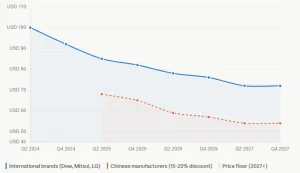
Market Insight: China’s POE not only achieved domestic localized substitution (dependence on imports dropped from 95% to about 76%) but its export volume is also expanding steadily, with products exported in bulk to overseas modification and photovoltaic manufacturing markets in Vietnam, Thailand, Russia, and India.
Core Selection References for POE Procurement
When procuring and selecting POE grades, it is recommended to evaluate from the following dimensions of technical indicators and supply channels:
- Copolymer Type Selection:
- Octene-based: Higher elasticity, lower density, and excellent low-temperature toughness, suitable for high-end scenarios like automotive modification and photovoltaic film.
- Butene-based: Good processability, better cost-performance ratio, suitable for conventional plastics modification and general-purpose footwear.
- Melt Index (MI) Matching:
- Low MI (0.5-3 g/10min): High melt strength, suitable for extrusion, blow molding, pipe, and filament processing.
- High MI (10-25 g/10min): Excellent flowability, suitable for fast injection molding, high-filling modification masterbatches, and complex mold molding.
- Core Physical Property Benchmarking:
- Automotive toughening: Focus primarily on notched impact strength at room/low temperature, hardness (Shore A), and rebound rate.
- Photovoltaic encapsulation: Must strictly control water vapor transmission rate, volume resistivity (recommended >= 10^15 ohm*cm), and high light transmittance (>= 91%).
- Supplier Strategy:
- Under the premise of ensuring consistency and meeting international certifications like RoHS, REACH, and UL, mature local Chinese suppliers (such as Wanhua, Dushanzi Petrochemical, Bio-one, etc.) can be considered extremely cost-effective stable supply sources or import substitution solutions.