Why Flame Retardancy Is a Hard Requirement: Three Levels of Standards
Flame-retardant plastics are specified at three different levels, and mixing them up is the most common source of project delays.
- Material level: UL 94 describes a material’s burning behaviour; the UL 746 series covers long-term electrical performance (including CTI and arc resistance); the UL Yellow Card is the formal, grade-level record of what a specific compound has actually been tested to.
- Component and end-product level: household appliances follow IEC 60335-1, which adds glow-wire and needle-flame requirements; industrial control panels follow standards such as NFPA 79, where UL 94 V-0 is often the minimum accepted material threshold.
- The critical point: a V-0 material does not guarantee end-product approval. The finished product must still satisfy wall thickness, creepage distance, glow-wire temperature bands, needle-flame and small-part tests. Conversely, a material rated below V-0 may still pass inside certain constructions. Start by identifying which clause at which level must be met, then work back to the material rating.
The UL 94 Rating System: Grades, Times and Drip Rules
In the vertical burn (V) tests, a 20 mm flame is applied twice for 10 s to a vertically mounted specimen. The 5V series instead uses a 125 mm flame, applied five times for 5 s to both bar and plaque specimens.
| Rating | Specimen | Afterflame per application | Total afterflame | Afterflame + afterglow (after 2nd application) | Flaming drips igniting cotton | Notes |
|---|---|---|---|---|---|---|
| HB | Horizontal | Burn rate ≤40 mm/min (3–13 mm thick) | — | — | Permitted | Lowest threshold |
| V-2 | Vertical (20 mm flame ×2) | ≤30 s | ≤250 s (over 10 applications) | ≤60 s | Permitted | General electrical parts |
| V-1 | Same as above | ≤30 s | ≤250 s | ≤60 s | Not permitted | General electrical parts |
| V-0 | Same as above | ≤10 s | ≤50 s | ≤30 s | Not permitted | Default requirement for most E&E parts |
| 5VB | Bar + plaque (125 mm flame ×5) | Afterflame + afterglow ≤60 s | — | — | Not permitted | Plaque may burn through |
| 5VA | Same as above | Afterflame + afterglow ≤60 s | — | — | Not permitted | Plaque must not burn through (most severe) |
Three details that are easy to get wrong:
- The rating is tied to wall thickness. The same material can be listed differently at 1.5 mm and 3.0 mm — quoting “V-0” without a thickness is an incomplete statement.
- Colour and additive package change results. Different colour masterbatches on the same grade may achieve different ratings; yellow cards therefore list colour ranges.
- 5V is not simply an upgraded V-0. The 5V family addresses thicker parts and enclosures, with different specimens and judgement criteria; it is a different test route, not a higher rung on the same ladder.
The Glow-Wire System: The Appliance Industry’s Parallel Route
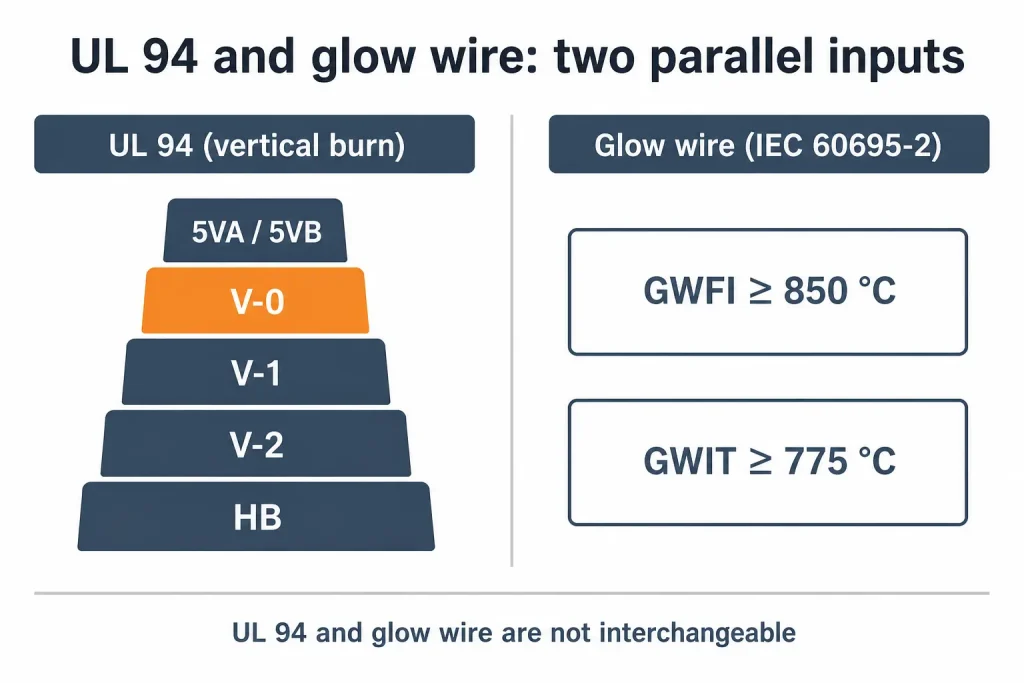
UL 94 asks whether a material keeps burning after ignition; glow-wire testing (IEC 60695-2 series) asks whether a part ignites when touched by a hot source, and whether drips ignite the layer below. The two are not interchangeable.
| Index | Meaning | Typical appliance requirement |
|---|---|---|
| GWFI (Glow-Wire Flammability Index) | At a specified temperature, afterflame ≤30 s within 30 s of removing the glow wire, with no ignition of the underlying layer by drips | ≥850 °C (insulating materials in unattended appliances) |
| GWIT (Glow-Wire Ignition Temperature) | The temperature at which the material ignites (burning >5 s) plus 25 °C | ≥775 °C (relevant parts in unattended appliances carrying more than 0.2 A) |
- The test temperature bands actually called up in appliance clauses — commonly 550 / 650 / 750 / 850 °C — depend on the current carried and the distance from live parts. Selecting a “high-grade material” therefore does not automatically satisfy the end-product requirement.
- Engineering implication: treat the UL 94 rating and the glow-wire figures as two parallel inputs, not as alternatives to choose between.
Flame-Retardant Mechanisms and Additive Systems: Every Benefit Has a Cost
| System | Typical chemistry | Advantages | Trade-offs |
|---|---|---|---|
| Halogenated (mainly brominated) | Brominated epoxy, TBBA types | High efficiency, low loading, controllable cost | Smoke density and corrosive gases; specific substances (e.g. PBB/PBDE) are restricted; some systems affect CTI |
| Phosphorus-based | DOPO derivatives, phosphinates, red phosphorus | Halogen-free, moderate efficiency | Higher cost; some systems have poor hydrolysis resistance or exudation risk |
| Intumescent | Ammonium polyphosphate (APP) systems | Char formation and heat shielding; suited to polyolefins | High loadings, noticeable loss of mechanical performance |
| Inorganic | Aluminium/magnesium hydroxide | Smoke suppression, low cost | Requires 40–60 % loading; impact and processing suffer markedly |
| Silicone-based | Organosilicon systems | Combines char formation with flow | Expensive; usually used as a synergist |
Side effects that must be evaluated: lower impact toughness, poorer weathering and colour stability, changes in CTI/tracking resistance, a lower processing temperature ceiling (additive decomposition causes splay, odour and mould corrosion), and loss of balance in the flame-retardant system when regrind is introduced.
Material Family Selection: The Ceiling Depends on the Base Resin
| Material family | Typical achievable rating (verify on the yellow card) | Characteristics and trade-offs | Typical applications |
|---|---|---|---|
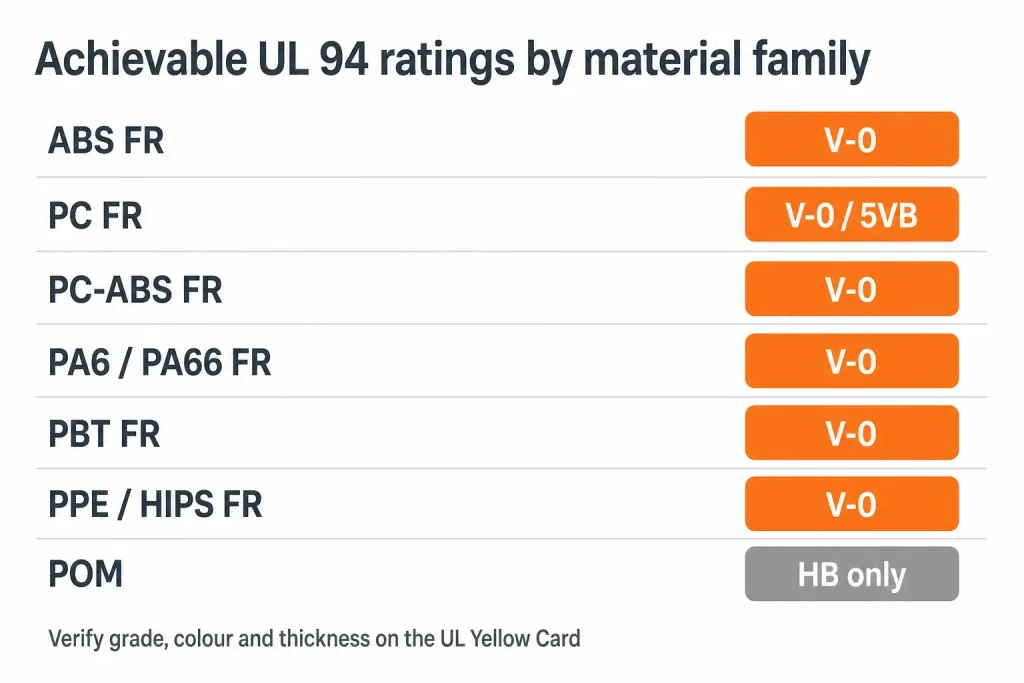
| ABS FR | V-0 (approx. 1.5–3.0 mm) | Cost-effective, good flow; impact and weathering reduced, brominated systems common | Appliance internals, power-supply housings |
| PC FR | V-0 (approx. 1.5–3.0 mm); some grades 5VB | High strength and heat resistance; higher cost, hydrolysis and weathering require modified grades | Power supplies, circuit breakers, lighting |
| PC-ABS FR | V-0 | Balanced flow, impact and cost; mainstream for E&E enclosures | IT/telecom equipment housings, adapters |
| PA6 / PA66 FR | V-0 (including glass-fibre grades) | Good mechanical and chemical performance; moisture uptake affects electrical performance — watch CTI | Connectors, circuit breakers, switches |
| PBT FR | V-0 | Good electrical performance and dimensional stability, fast crystallisation | Connectors, coil formers |
| PPE/HIPS FR | V-0 | Low density, dimensionally stable, moderate cost | TV and monitor rear covers |
| POM | Usually HB only | Low decomposition temperature; unstable with acidic or halogenated systems — flame-retardant modification is difficult in practice | Consider switching material family |
| PP FR | V-0 / V-2 (high loading) | Low cost, but mechanical and thermal performance fall noticeably | Household and low-load electrical parts |
For grade-level examples already covered on this site, see Covestro Bayblend FR3010 for E&E enclosures and Geon M5240 electronic enclosures.
Design and Processing Essentials
- Thickness first: determine the thinnest wall section of the part, then check the rating the yellow card lists for that thickness.
- Three checks on the yellow card: grade, colour and thickness must match the rating shown, and the electrical parameters (CTI in particular) should be reviewed at the same time.
- CTI and creepage distance work together: CTI is classified by UL 746A into PLC 0–5 (≥600 V / 400–599 V / 250–399 V / 175–249 V / 100–174 V / <100 V). Flame-retardant systems can reduce CTI, which then eats into the creepage-distance margin of the design.
- Regrind management: regrind dilutes the flame-retardant system; limit the ratio and re-test.
- Processing window: FR grades usually have a lower barrel-temperature ceiling than the unfilled base resin; overheating causes exudation, odour and mould corrosion.
- Verification sequence: material level (yellow card plus glow-wire data) → component level (needle-flame, glow-wire tests on the actual part) → end product (60335 or the applicable product standard).
Selection Checklist
- Application standard: appliances, IT equipment, industrial control and lighting each call up different clauses.
- Thickness and rating: look up the rating for the thinnest wall.
- Two parallel inputs: UL 94 rating and glow-wire (GWIT/GWFI) requirements.
- Electrical coordination: CTI, creepage distance and arc-resistance requirements.
- Material family screening: shortlist from the table above, then verify the specific grade.
- Processing and cost constraints: temperature window, mould corrosion, additive cost.
- Validation and documentation: yellow card, test reports and batch consistency (especially colour and regrind ratio).
FAQ
1. If the material is V-0, will the end product always pass?
No. The finished product still needs glow-wire, needle-flame and creepage-distance verification; a material rating is only one necessary condition among several.
2. Is halogen-free always better than brominated?
Not categorically. Halogen-free systems are usually better on smoke toxicity and corrosive gases, but they can be less efficient, need higher loadings, cost more and cause greater mechanical loss. The decision should follow the end-product standard and measured data.
3. Why are flame-retardant grades more brittle?
Flame-retardant additives sit largely as a dispersed phase and interfere with the crazing and shear-yielding mechanisms of the base resin. The more efficient the system and the higher the loading, the greater the impact loss — impact-modified, synergistic systems can recover part of it; see PC-ABS properties for how impact modification is typically handled in an FR-capable blend.
4. Can UL 94 and glow wire replace each other?
No. The heat source, the way it is applied and the pass criteria all differ, and appliance projects normally require both.
5. Why does the same material have different ratings? Thickness, colour, additive system and the test revision all affect the outcome, so a rating must always be read as “grade + colour + thickness”.
Conclusion
Flame-retardant selection is essentially the exercise of translating end-product clauses into material-level figures: identify the application standard and the thinnest wall first, then treat the UL 94 rating and the glow-wire figures as two parallel inputs, and finally screen the material family and verify against the yellow card. Avoiding three common mistakes — treating V-0 as a pass for everything, using UL 94 in place of glow wire, and separating the rating from thickness — usually removes repeated burn-test iterations at the prototype stage, saving both time and cost.