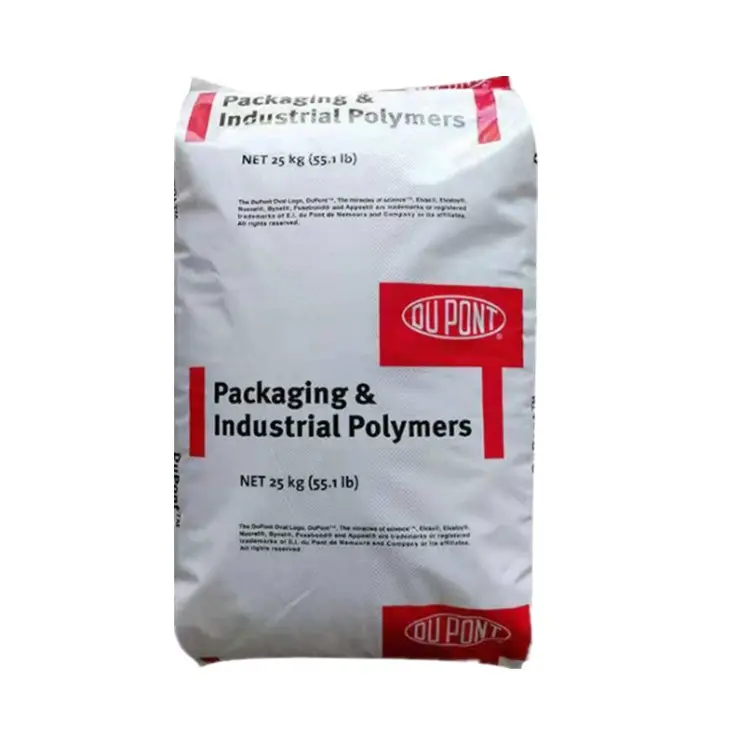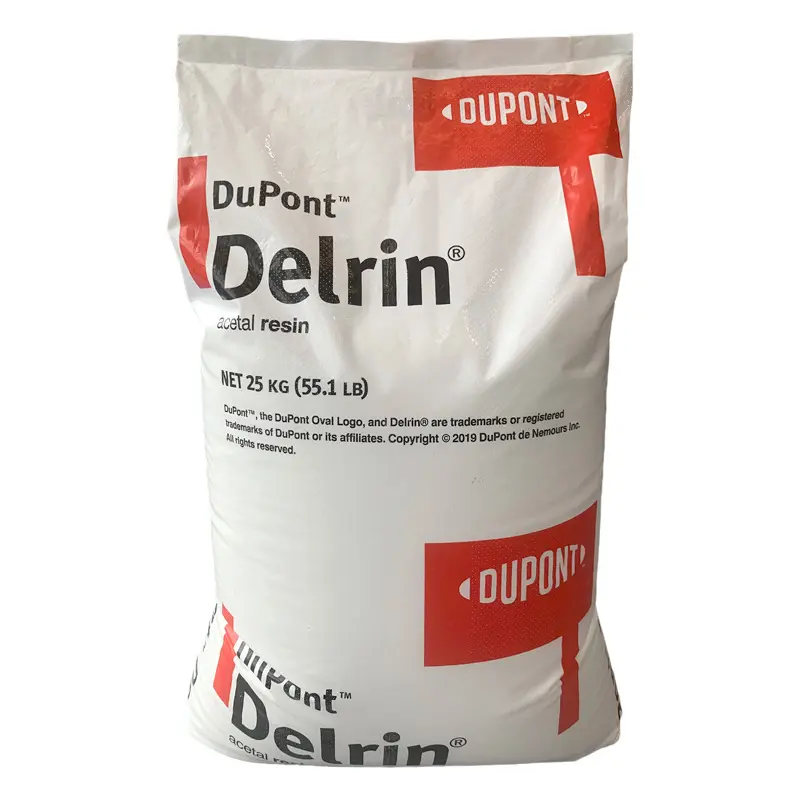
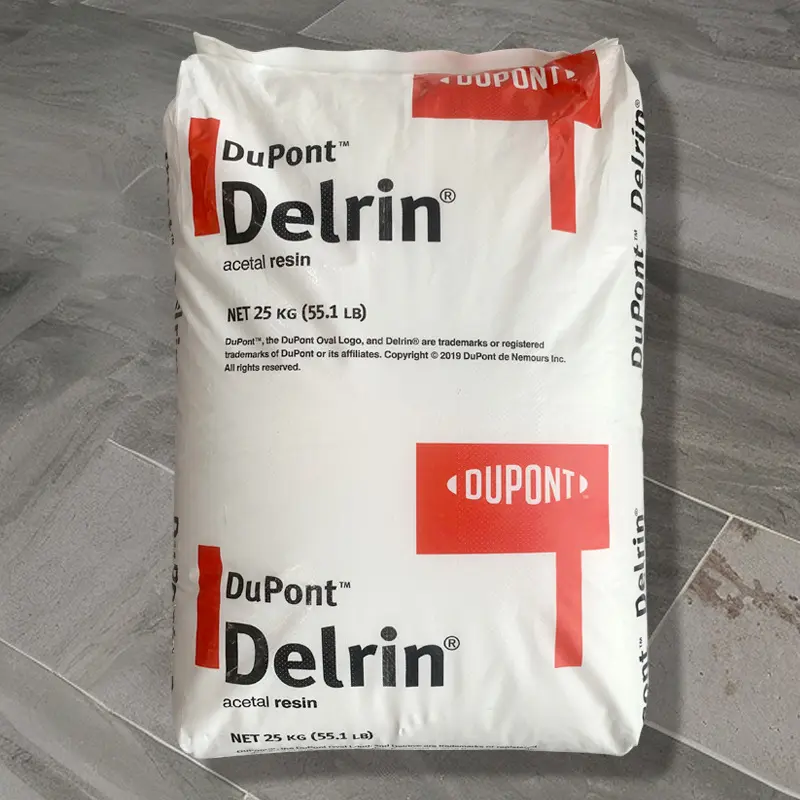
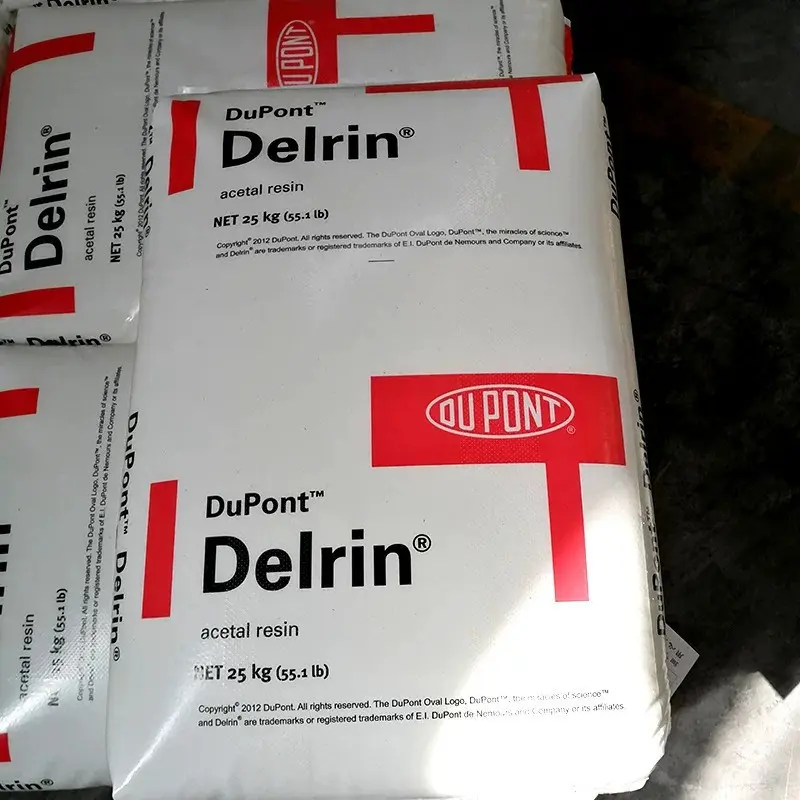
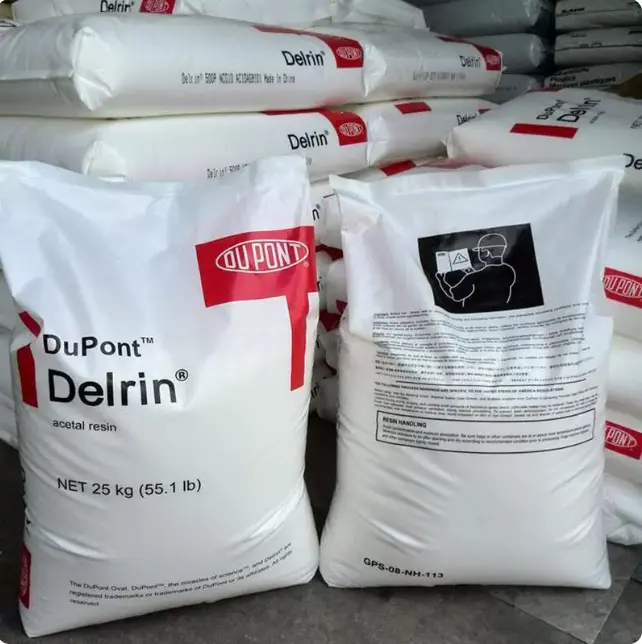
DuPont Delrin 500P is a general-purpose injection molding homopolymer POM resin featuring high rigidity, a density of 1.42 g/cm³, a flexural modulus of 3220 MPa, and exceptional wear and fatigue resistance for demanding structural components.
| Manufacturer | DuPont |
|---|---|
| Density | 1.42 g/cm³ |
| Tensile Strength at Yield | 69 MPa |
| Flexural Modulus | 3220 MPa |
| Izod Notched Impact | 1620 kJ/m² |
Note: See the product description for additional technical specifications
Delrin® 500P is a general-purpose injection molding grade of polyoxymethylene homopolymer (POM-H) developed by DuPont and now belonging to the Delrin® brand portfolio. The material is supplied in natural color opaque pellets (optional NC010 Natural / BK261 Black), with a density of 1.42 g/cm³ and a melting point of 175 °C (ASTM D2133). It is a medium-viscosity, standard-grade resin equipped with an internal lubrication and mold-release system. In the POM industry, 500P is regarded as the benchmark reference grade for general wear-resistant structural parts—featuring a tensile yield strength of 69 MPa (at 23 °C), a flexural modulus of 3220 MPa, a Charpy unnotched impact strength of 1620 kJ/m², and a fatigue limit of 32 MPa (10^6 cycles). Combined with a low 24-hour water absorption of 0.25% and a mold shrinkage rate of 2.2–2.4%, it has long been widely used in “metal-to-plastic” substitution applications such as gears, bearings, snaps, and transmission components. This grade is suited for injection molding and serves as a highly balanced engineering plastic extensively utilized in the automotive, OA equipment, industrial transmission, and consumer goods sectors.
| Property | Testing Condition | Value | Unit | Test Method |
| Water Absorption | 24-hour immersion | 0.25 | % | ASTM D570 |
| Water Absorption | Equilibrium saturation | 0.9 | % | ASTM D570 |
| Water Absorption | 50% relative humidity | 0.22 | % | ASTM D570 |
| Density | — | 1.42 | g/cm³ | ASTM D792 |
| Mold Shrinkage | — | 2.2 to 2.4 | % | Internal Method |
| Property | Testing Condition | Value | Unit | Test Method |
| Tensile Modulus of Elasticity | — | 3640 | MPa | ASTM D638 |
| Tensile Yield Strength | 23°C | 69 | MPa | ASTM D638 |
| Tensile Yield Strength | 100°C | 36 | MPa | ASTM D638 |
| Tensile Yield Strength | 70°C | 48 | MPa | ASTM D638 |
| Tensile Yield Strength | 122°C | 26 | MPa | ASTM D638 |
| Tensile Yield Strength | -55°C | 101 | MPa | ASTM D638 |
| Rockwell Hardness | M | 94 | — | ASTM D785 |
| Rockwell Hardness | R | 120 | — | ASTM D785 |
| Fatigue Limit | 50%RH, 23°C, 106 cycles | 32 | MPa | ASTM D671 |
| Flexural Modulus | -55°C | 4730 | MPa | ASTM D790 |
| Flexural Modulus | 100°C | 1030 | MPa | ASTM D790 |
| Flexural Modulus | 122°C | 755 | MPa | ASTM D790 |
| Flexural Modulus | 70°C | 1720 | MPa | ASTM D790 |
| Flexural Modulus | 23°C | 3220 | MPa | ASTM D790 |
| Compressive Strength | 23°C, 1% strain | 35 | MPa | ASTM D695 |
| Compressive Strength | 23°C, 10% strain | 121 | MPa | ASTM D695 |
| Elongation at Break | -55°C | 10 | % | ASTM D638 |
| Elongation at Break | 100°C | >260 | % | ASTM D638 |
| Elongation at Break | 23°C | 25 | % | ASTM D638 |
| Elongation at Break | 122°C | >260 | % | ASTM D638 |
| Elongation at Break | 70°C | 180 | % | ASTM D638 |
| Flexural Strength | 23°C | 97 | MPa | ASTM D790 |
| Charpy Notched Impact Strength | -40°C | 55 | kJ/m² | ASTM D256 |
| Charpy Unnotched Impact Strength | 23°C | 1620 | kJ/m² | ASTM D256 |
| Shear Strength | 23°C | 66 | MPa | ASTM D732 |
| Property | Testing Condition | Value | Unit | Test Method |
| Heat Deflection Temperature | 0.5 MPa | 172 | °C | ASTM D648 |
| Heat Deflection Temperature | 1.8 MPa | 136 | °C | ASTM D648 |
| Thermal Conductivity | Heat Deflection Temp 1.8 MPa | 0.37 | W/(K·m) | Internal Method |
| Coefficient of Linear Thermal Expansion | 29 to 60°C | 12.2×10⁻⁵ | 1/°C | ASTM D696 |
| Coefficient of Linear Thermal Expansion | 60 to 104°C | 13.7×10⁻⁵ | 1/°C | ASTM D696 |
| Coefficient of Linear Thermal Expansion | 104 to 160°C | 14.9×10⁻⁵ | 1/°C | ASTM D696 |
| Coefficient of Linear Thermal Expansion | -40 to 29°C | 10.4×10⁻⁵ | 1/°C | ASTM D696 |
| Melting Point | — | 175 | °C | ASTM D2133 |
| Property | Testing Condition | Value | Unit | Test Method |
| Dielectric Strength | Short time (2.3 mm) | 19.7 | kV/mm | ASTM D149 |
| Dielectric Constant | 50%RH, 23°C, 106 Hz | 3.7 | — | ASTM D150 |
| Dielectric Constant | 50%RH, 23°C, 102 to 106 Hz | 3.7 | ohms·cm | ASTM D150 |
| Volume Resistivity | 23°C, 0.2% moisture content | 1×10¹⁵ | ohms·m | ASTM D257 |
| Arc Resistance | 3.1 mm | 220 | sec | ASTM D495 |
| Property | Testing Condition | Value | Unit | Test Method |
| Flame Rating | — | HB | — | UL 94 |
| Property | Testing Condition | Value | Unit | Test Method |
| Tensile Impact | Long specimen, 23°C | 250 | kJ/m² | ASTM D1822 |
| Deformation Under Load | 140 kg/cm², 50°C | 0.5 | % | ASTM D621 |
| Izod Impact Strength | 23°C | 71 | kJ/m² | ASTM D256 |
The technical data sheet (TDS) of Delrin® 500P material from DuPont corporation, if there are differences, please refer to the official website of DuPont.
High Rigidity and High Strength Homopolymer Structure: With a density of 1.42 g/cm³, a flexural modulus of 3220 MPa (at 23 °C), and a tensile yield of 69 MPa, its rigidity ranks at the higher end among unreinforced engineering plastics, allowing it to substitute for brass and zinc alloy in load-bearing structural components.
Superior Fatigue and Creep Resistance: Features a fatigue limit of 32 MPa (10^6 cycles), exhibiting slow dimensional and performance degradation under long-term reciprocating loads (gears, snaps, hinges), making it suitable for million-cycle dynamic working conditions.
Self-Lubricating, Low-Friction Wear Resistance: Homopolymer POM features regular molecular chains and high crystallinity, resulting in significantly lower wear under dry friction conditions compared to copolymer POM, enabling its use in bearings, sliders, and transmission pairs without external lubricating oil.
Low Moisture Absorption and Dimensional Stability: A 24-hour water absorption rate of 0.25% and controllable mold shrinkage under temperature and humidity fluctuations (2.2–2.4%) make precision molded part tolerances easier to maintain, outperforming hygroscopic materials like PA and PC.
Wide Temperature Range Toughness Retention: Retains a tensile yield of 101 MPa even at -55 °C, an elongation at break of 25% at 23 °C, and >260% elongation at 122 °C, adapting to continuous operating environments from -40 to 90 °C.
Automotive Transmission & Interior: Door lock mechanisms, seat belt buckles, seat adjustment gears, window regulator rocker arms, non-contact fuel pump module parts, and wiper linkage bushings.
OA & Electronics: Printer/copier pickup rollers and transmission gears, scanner racks, connector housings, switch buttons, and micro-motor worms.
Industrial Machinery: Water pump impellers, valve cores, bearing cages, cams, slider guide rails, conveyor belt links, and pneumatic fittings.
Consumer & Daily Chemicals: Zipper teeth, sprayer pump stems, electric toothbrush gears, coffee machine hinges, bathroom showerhead knobs, and high-load toy structural parts.
Note: Delrin® 500P is a homopolymer POM; its resistance to strong alkalis and hot water hydrolysis is weaker than that of copolymer POM (such as Hostaform C9021), and it is not resistant to concentrated strong acids and strong oxidizing agents. Long-term outdoor exposure requires anti-UV modified grades (such as 527UV).
Q1: Is pre-drying mandatory before injection molding 500P? Recommended processing parameters?
A1: Although POM has low moisture absorption, homopolymer POM is more sensitive to hydrolysis. Hot-air drying at 80–90 °C for 3–4 hours is recommended to keep the target moisture content ≤ 0.02%, preventing silver streaks and molecular weight reduction. Barrel temperatures should be maintained at 190–210 °C (strictly avoiding temperatures above 215–220 °C, otherwise formaldehyde release and degradation will occur), mold temperatures at 80–100 °C to promote crystallinity and dimensional stability, and screw residence time should be kept as short as possible.
Q2: How to choose between Delrin® 500P (homopolymer) and Hostaform C9021 (copolymer)?
A2: 500P offers superior rigidity, wear resistance, and fatigue resistance (tensile strength of 69 vs 64 MPa, comparable notched impact but lower wear), making it suitable for precision transmission/load-bearing parts in dry environments. C9021 offers better alkali resistance, hot water hydrolysis resistance, and a wider processing window, making it suitable for water-contact, sanitary, fuel-contact, and thick-walled extrusion applications. Choose copolymer if the end-use involves high-temperature water or strong alkaline cleaning agents; choose 500P for oil-free wear resistance and high rigidity.
Q3: What are the compliance and certification statuses of this grade regarding UL and food contact?
A3: The base grade 500P has a UL 94 flame retardant rating of HB (1.5 mm / 3.0 mm), not V-0; virgin resin complies with RoHS and REACH restricted substance frameworks. The natural color NC010 can provide FDA 21 CFR 177.2470 food contact declarations and USP Class VI medical-grade documentation according to market requirements, but final qualification must be verified via testing on finished parts, as compliance cannot be determined solely on the base resin.
Q4: Can 500P be used to extrude rods or sheets?
A4: 500P is positioned as an injection molding grade (medium viscosity). While small-caliber extrusion is possible, the thermal stability of homopolymer POM during slow extrusion is inferior to that of copolymer POM, making it prone to yellowing and bubbles. For rods, sheets, or thick-walled tubes, Delrin extrusion-dedicated grades or copolymer POM (such as Hostaform C9021) are recommended; 500P is not recommended as a primary grade for extrusion.
Submit your inquiry today and receive a professional competitive price tailored to your project requirements.