Table of Contents
- What is POM?
- Core Properties at a Glance
- Homopolymer POM vs. Copolymer POM: What is the Difference?
- Primary Applications
- What POM Can and Cannot Do
- Frequently Asked Questions (FAQs)
What is POM?
Polyoxymethylene (POM), also commonly referred to as acetal, polyacetal, or polyformaldehyde resin, is a high-performance engineering plastic utilized for manufacturing precision components that demand high rigidity and exceptional dimensional stability.
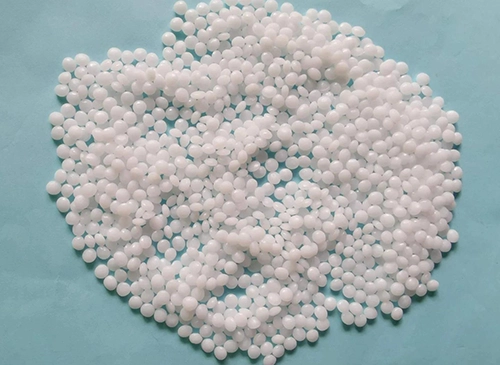
It can be conceptualized as a “plastic that performs like metal.” It features high strength and excellent stiffness, maintaining tight dimensional tolerances even after hundreds of thousands of cycles. Consequently, engineers frequently specify POM as a direct replacement for metal across the automotive, electronics, and industrial machinery sectors.
POM is inherently an opaque white material with a high crystallinity of 70–80% and a density of approximately 1.41–1.42 g/cm³. It retains its outstanding mechanical properties over a broad temperature spectrum, ranging from -40°C to 100–120°C.
POM was first synthesized by German chemist Hermann Staudinger in the 1920s. However, it was not until 1956 that DuPont commercialized homopolymer POM under the trade name Delrin®. In 1962, Celanese introduced the first copolymer POM (Celcon®), which offered further enhancements in thermal stability and chemical resistance.
Core Properties at a Glance
| Performance Indicators | Typical Range | Why It Matters |
| Tensile Strength | 55–70 MPa | High load-bearing capacity; serves as a metal substitute for structural parts |
| Flexural Modulus (Stiffness) | 2,600–3,200 MPa | Robust resistance to bending and deformation under mechanical load |
| Wear Resistance | Extremely High | Long service life for gears, bearings, and sliding components |
| Coefficient of Friction | Extremely Low | Delivers smooth motion, often reducing or eliminating the need for lubrication |
| Water Absorption | < 0.2% | Exceptional dimensional stability in humid conditions—far superior to nylon |
| Continuous Service Temperature | -40°C to 100°C (up to 120°C) | Suitable for the vast majority of indoor and automotive applications |
| Chemical Resistance | Good | Resists oils, fuels, solvents, and neutral chemicals |
Note: The values listed above represent typical operating ranges; please consult specific material data sheets for precise specifications.
Homopolymer POM vs. Copolymer POM: What is the Difference?
POM is available in two primary variants. Selecting the appropriate type is critical to the success of an application.
| Comparison | Homopolymer POM (POM-H) | Copolymer POM (POM-C) |
| Strength & Stiffness | Higher (approx. 10–15% more) | Slightly Lower |
| Chemical Resistance | Lower—vulnerable to strong acids | Superior; resists acids, alkalis, and hot water |
| Thermal Stability | Lower—narrow processing window | Higher—more forgiving processing parameters |
| Water Absorption | Extremely Low (< 0.2%) | Extremely Low (< 0.2%) |
| Processability | Requires precise temperature control | Easier and more stable to process |
| Best-Use Scenarios | Demanding peak mechanical performance | Exposure to chemicals, hot water, or high temperatures |
| Representative Brands | Delrin® (DuPont), Tenac® (Asahi Kasei) | Celcon®, Hostaform®, Duracon®, Ultraform® |
Simple Rule of Thumb:
- If the primary requirement is maximum strength and stiffness → Select Homopolymer POM.
- If the component will encounter chemicals, hot water, or complex processing setups → Select Copolymer POM.
Primary Applications
Leveraging its unique combination of strength, wear resistance, and dimensional stability, POM is widely adopted across various industries:
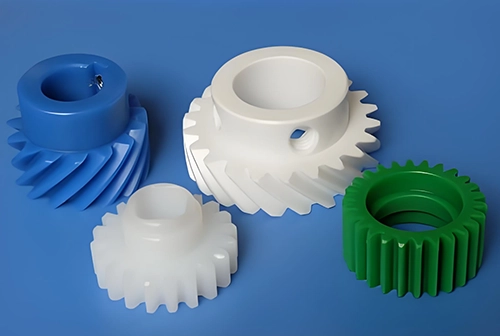
- Automotive Industry: Fuel system components (pump housings, carburetor parts), seat belt mechanisms, door handles, window lifter gears, and interior trim components. POM reduces vehicle weight while maintaining performance both inside and outside the engine compartment.
- Consumer Electronics: Keyboard mechanisms, switches, connectors, printer parts, and precision internal gears for smartphones and laptops. The dimensional stability of POM ensures that tight tolerances are maintained in compact assemblies.
- Industrial Machinery: Gears, bearings, bushings, pump impellers, conveyor system components, and wear strips. The low friction of POM minimizes energy loss and extends maintenance intervals.
- Consumer Goods & Home Appliances: Zippers, locks, handles, dishwasher components, food processor gears, and internal mechanisms for coffee makers. POM delivers a balance of mechanical strength and smooth, aesthetic surfaces.
- Plumbing & Fluid Handling: Valves, water meter components, pipe fittings, and pump bodies. POM exhibits extremely low water absorption and resists scaling, making it an ideal choice for water-contact applications.
- Food Contact & Medical: Specific copolymer POM grades comply with FDA 21 CFR §177.2470, hold NSF 61 drinking water certification, and meet EU food contact regulation (EC) No 10/2011. These grades are suitable for food processing equipment and non-implantable medical device components. Note: Not all POM grades carry food or water contact certifications; always verify regulatory status for your specific grade and region.
What POM Can and Cannot Do
Where POM Excels:
- Precision parts requiring exceptionally tight dimensional tolerances.
- Moving parts demanding a low coefficient of friction and extended wear life.
- Metal replacement applications aimed at weight reduction.
- Environments with continuous exposure to oils, fuels, and most organic solvents.
- High-volume production via injection molding or high-precision CNC machining.
Where POM is Unsuitable (Limitations):
- Outdoor applications without UV stabilizers—prolonged sunlight exposure causes UV degradation.
- Strong acid environments (pH < 4)—POM is susceptible to severe chemical attack.
- High-temperature environments where continuous exposure exceeds 120°C (PEEK should be selected instead).
- Applications requiring adhesive bonding—POM features an extremely low surface energy, making it difficult to bond with standard glues.
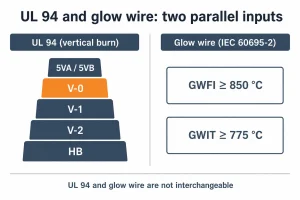
- Environments with strict flame-retardant mandates—standard POM is rated UL 94 HB (slow burning).
Frequently Asked Questions (FAQs)
Q1: Are POM and acetal the same material?
Yes. “Polyoxymethylene” (POM), “acetal”, and “polyacetal” all refer to the same family of engineering plastics. However, it is essential to distinguish between homopolymer and copolymer grades, as their performance profiles differ significantly.
Q2: Can POM be used for drinking water or food contact applications?
Yes, specific copolymer POM grades comply with FDA 21 CFR §177.2470 food contact standards and carry drinking water approvals such as NSF 61, KTW, and WRAS. However, you must verify compliance for the exact grade in your specific region—not all POM grades are approved.
Q3: Why is POM preferred over nylon in humid environments?
Nylon can absorb up to 8% moisture, leading to dimensional swelling and a drop in mechanical properties. In contrast, POM maintains a water absorption rate below 0.2%, ensuring its dimensions and mechanical performance remain stable even when submerged or exposed to high humidity. This makes POM the definitive choice for fluid handling.
Q4: Is POM difficult to bond or glue?
Yes. POM has a very low surface energy, making it highly resistant to conventional adhesives. For components requiring permanent assembly, mechanical fastening (snap-fits, screws) or ultrasonic welding is highly recommended.
Q5: Is POM recyclable?
Yes, POM is 100% recyclable. Post-industrial regrind generated during manufacturing can typically be reprocessed and blended back into non-critical applications with minimal loss in properties, supporting a circular economy in high-volume production setups.