In the large family of high-performance thermoplastic elastomers (TPE), SEBS is recognized as a “king polymer” with high technical content, thanks to its excellent balance of physical properties, unparalleled weatherability, and extremely broad processing window. Whether in automotive interiors, soft-touch handles, medical devices, or specialty adhesives, SEBS plays an indispensable role.
This article will comprehensively reveal the technical essence of this core raw material from five dimensions: polymer chemistry, property comparison, technical characteristics, downstream applications, and environmental compliance.
What Does SEBS Stand For? (Chemical Structure and Composition)
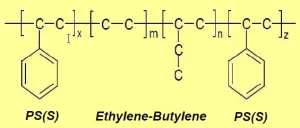
SEBS stands for Styrene-Ethylene-Butylene-Styrene Block Copolymer. From a classification perspective, it belongs to the hydrogenated premium class of styrenic block copolymers (SBC / HSBC).
Its molecular chain exhibits a unique linear triblock structure:
- Hard Segments (Both Ends): Consist of polystyrene blocks, which endow the material with physical strength, dimensional stability, and hardness support similar to rigid plastics.
- Soft Segment (Middle): Consist of a completely hydrogenated, saturated rubbery poly(ethylene-butylene) block, which endows the material with excellent flexibility, elasticity, and elongation.
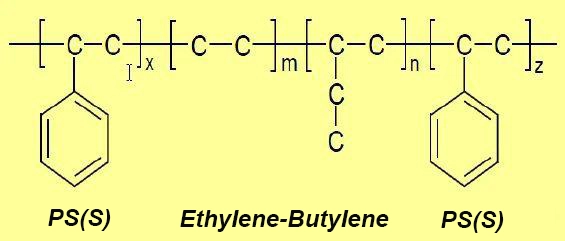
This microscopic “sea-island structure” and phase separation characteristic allow SEBS to exhibit the high elasticity and fatigue resistance of vulcanized rubber at room temperature, while possessing the plasticity and high flowability of thermoplastics at high temperatures, completely eliminating the processing constraints of traditional vulcanized rubber.
SEBS vs. SBS: What is the Difference and Why Hydrogenation Matters?
In the field of thermoplastic elastomers, buyers frequently compare SEBS with its predecessor material, SBS (Styrene-Butadiene-Styrene). The most fundamental technical watershed between the two lies in the “hydrogenation” process of the midblock.
| Technical Indicators / Performance | SBS (Unhydrogenated Predecessor) | SEBS (Fully Hydrogenated Premium Material) |
| Microscopic Molecular Chain Structure | The middle carbon chain contains a large number of unsaturated double bonds (C=C). | The middle double bonds are completely hydrogenated and saturated into single bonds (C-C). |
| UV Resistance and Weatherability | Extremely poor. Double bonds are easily cleaved by UV light, leading to discoloration and stickiness. | Outstanding. The molecular chain is extremely stable, possessing inherent UV and sunlight resistance. |
| Thermal Aging Performance | Weak. Prone to thermal oxidative degradation during high-temperature processing or long-term use. | Strong. Excellent thermal shear stability, allowing stable processing at 190°C–250°C. |
| Application Preferences | Limited to ordinary footwear soles, indoor asphalt modification, and low-to-mid-end adhesives. | Widely used in premium automotive interiors, outdoor building materials, medical devices, and skin-friendly overmolding. |
Why is hydrogenation critical? When traditional SBS is exposed to sunlight, ozone, or high temperatures, the unsaturated double bonds on its molecular chain act as an “Achilles’ heel,” easily undergoing oxidative cleavage, which causes the final product to yellow, embrittle, or become sticky. SEBS utilizes catalytic hydrogenation technology to completely saturate these double bonds, giving its molecular structure high stability similar to polyolefins, which multiplies its outdoor service life and environmental stress cracking resistance (ESCR).
Key Properties and Technical Characteristics of SEBS Material
As a high-grade compound base resin, SEBS demonstrates a series of unparalleled technical strengths in practical industrial applications:
- Extremely Broad Hardness Adjustment Range: The Shore A hardness of pure SEBS resin itself is typically between 40 and 75. However, due to its powerful capacity to absorb mineral oil (white oil) and polyolefins, its hardness can be significantly reduced to Shore 00 (exhibiting an ultra-soft gel state resembling human fat, known as SEBS Gel) or increased to Shore D through compounding, meeting a full spectrum of requirements from ultra-soft to rigid.
- Excellent Transparency: The linear structure of SEBS features an extremely low optical yellowness index and high light transmittance. It can not only be used to manufacture completely transparent consumer goods, but also retains the original transparency of the matrix plastic to the maximum extent when used as an impact modifier or toughening agent.
- Outstanding Mechanical Elasticity and Elongation at Break: Typical grades of SEBS products possess high tensile strength (up to more than 20 MPa) and astonishing elongation properties (elongation at break is typically between 500% and 800%), with very low compression set at elevated temperatures.
- Superior Processing Flowability: Modern chemical synthesis technologies endow specific SEBS grades (such as those with high diblock content or specific molecular weights) with high melt flow rates (MFR), making high-speed film extrusion, thin-wall injection molding, and complex co-extrusion straightforward.
Common Applications: What is SEBS Polymer Used For?
Because SEBS combines the ease of processing of plastics with the high elasticity of rubber, its downstream industrial applications are primarily concentrated in three core strategic sectors:
① High-End Plastic Modification and Engineering Overmolding
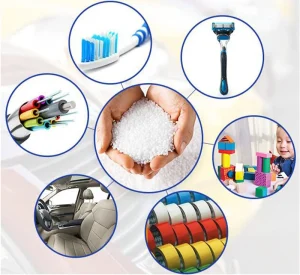
This is the most prevalent commercial application of SEBS. SEBS is frequently used as a core compatibilizer and impact modifier, compounded with polypropylene (PP), polystyrene (PS), or engineering plastics (such as PC, PPO). Through multi-shot injection molding processes, it is manufactured into power tool handles, toothbrush grips, automotive dashboard skins, and window seals. The skin-friendly, anti-slip, and vibration-dampening tactile feel (soft-touch) greatly increases the value of the end product.
② Medical Healthcare Devices and High-Purity Food Contact Parts
Benefiting from the extremely low residual volatiles and minimal extractables achieved by advanced synthesis processes, high-purity grade SEBS is an ideal eco-friendly alternative to traditional flexible PVC. It is extensively used to manufacture disposable medical tubing, dialysis masks, syringe plunger tips, baby bottle nipples, and soft gaskets for premium food packaging, and it fully withstands rigorous sterilization treatments such as ethylene oxide (ETO) or gamma radiation.
③ Specialty Adhesives, Waterproof Coatings, and Roof Coatings
Leveraging the excellent solution viscosity characteristics of SEBS in specific aromatic hydrocarbon solvents (such as maintaining a balanced toluene solution viscosity) and its inherent UV resistance, it is widely utilized as the core film-forming skeleton for high-performance hot-melt pressure-sensitive adhesives (HMPSA), high-end electronics sealants, and building SEBS roof coatings.
Is SEBS Plastic Safe and Eco-Friendly? (Compounding and Sustainability)
In mainstream international markets such as Europe and America, supply chain scrutiny regarding environmental compliance and material non-toxicity has reached unprecedented levels. SEBS possesses inherent green label advantages in these areas.
- Completely Free from Plasticizer Toxicity Risks: Traditional flexible PVC requires the addition of large amounts of phthalate plasticizers (such as DEHP) to achieve softness, which easily migrate out and pose reproductive toxicity risks. SEBS achieves its softness through the flexible midblocks within its own molecular chains and the addition of compliant, non-toxic, high-purity mineral oils. It contains zero phthalates, fully complying with the strictest international environmental regulations such as RoHS, REACH, and FDA.
- Zero Residual Heavy Metals and Harmful Substances: The catalytic and polymerization processes of major chemical manufacturers are stringently controlled, resulting in zero harmful heavy metals in the finished resin. This allows it to pass comprehensive toxicological safety assessments for children’s toys and skin-contact wearables.
- 100% Recyclable: Unlike traditional vulcanized rubbers (such as EPDM, NBR) that cannot be remelted once cured, SEBS is a true thermoplastic polymer. Its scraps and scrap products can be 100% recycled and re-granulated through re-heating and re-melting. Even after multiple recycling cycles, its property retention remains within highly controllable ranges. This excellent closed-loop recycling characteristic perfectly aligns with the green, low-carbon, and sustainability goals advocated by the global chemical supply chain.