Introduction of Polyvinyl Chloride
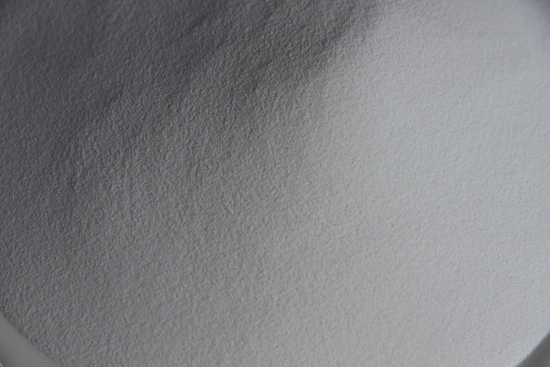
Polyvinyl chloride (Polyvinyl Chloride, referred to as PVC) is one of the plastic varieties with the largest production volume in the world. Along with polyethylene (PE) and polypropylene (PP), it is classified as one of the world’s top three general-purpose plastics. PVC is a thermoplastic polymer formed from vinyl chloride monomer (VCM) through a free radical polymerization reaction. The finished product appears as a white amorphous powder or granules, possessing excellent chemical stability, flame retardancy, and electrical insulation properties. It can be made into rigid or flexible products by adding different additives, finding extremely widespread utilization. According to the latest industry data, the global PVC market size is projected to reach approximately USD 80 billion to 118 billion by 2031 to 2033, with a compound annual growth rate of around 4%. The Asia-Pacific region is the world’s largest market for PVC production and consumption, with China ranking first globally in both production capacity and export volume.
What Is Polyvinyl Chloride Made Of
The basic raw materials of PVC come from two of the most common foundational resources—轮 and petroleum (or natural gas). Specifically, chlorine comes from salt (sodium chloride), obtained by the electrolysis of brine to produce chlorine gas; ethylene is extracted from petroleum or natural gas. Chlorine gas and ethylene react under strictly controlled conditions to generate ethylene dichloride (EDC), and then EDC is cracked through high temperature and high pressure to be converted into vinyl chloride monomer (VCM). Finally, VCM undergoes a polymerization reaction under the action of an initiator to generate polyvinyl chloride resin.
It is worth mentioning that, thanks to its high chlorine content of approximately 57%, the proportion of fossil raw materials used in PVC is lower than that of most other bulk plastics, thereby featuring a lower carbon footprint and resource consumption. In addition, ethylene can also originate from renewable resources. Bio-based and bio-attributed PVC resins are already available on the market through the mass balance approach, providing a new path for the sustainable development of PVC.
The production process of PVC consists of five main steps:
- Step 1 – Source salt and hydrocarbon resources: Obtain sodium chloride from salt mines, and obtain ethylene from petroleum/natural gas.
- Step 2 – Produce chlorine and ethylene: Electrolyze brine to make chlorine gas; crack and purify ethylene from petroleum/natural gas.
- Step 3 – Produce ethylene dichloride: Chlorine gas reacts with ethylene to generate EDC.
- Step 4 – Produce vinyl chloride monomer: EDC is cracked and converted into VCM under high temperature and high pressure.
- Step 5 – Polymerize to form PVC resin: VCM polymerizes to become PVC resin through suspension polymerization or emulsion polymerization methods.
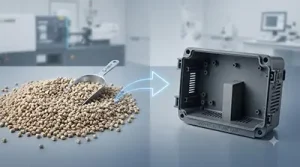
PVC resin itself is a white powder and cannot be used directly on machines. It needs to be compounded and blended (i.e., “compounding”) with additives such as stabilizers, plasticizers, lubricants, and pigments to be made into customized PVC compounds before final products can be manufactured through processing techniques such as extrusion, injection molding, calendering, and thermoforming. PVC is a thermoplastic, which can be repeatedly heated to soften and cooled to shape, and this is precisely the fundamental characteristic that allows it to be recycled and reused.
Types of Polyvinyl Chloride
According to different formulations and processing methods, PVC is mainly divided into the following major categories:
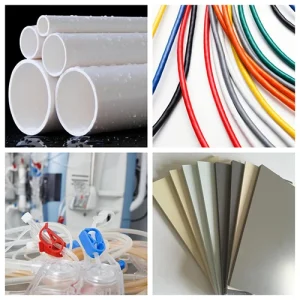
- (1) Rigid PVC (Rigid PVC / uPVC):This is the most commonly used type of PVC, where no plasticizer or only an extremely small amount of plasticizer is added, and the product appears in a hard and rigid state. It possesses excellent chemical corrosion resistance, weather resistance, and electrical insulation properties, widely used in construction fields such as water supply and drainage pipes, door and window profiles, and electrical conduits.
- (2) Flexible PVC (Flexible PVC / Plasticized PVC):By adding plasticizers (usually phthalates), the crystallinity between PVC molecular chains is reduced, endowing the material with flexibility and elasticity. The mass percentage of plasticizers is usually between 15% and 50% (i.e., adding 20 to 80 parts of plasticizer per 100 parts of resin). Flexible PVC is widely used in wire and cable insulation layers, hoses, toys, medical tubing, artificial leather, inflatable products, etc.
- (3) Chlorinated PVC (Chlorinated PVC, C-PVC):Further chlorination treatment is performed on PVC resin, allowing the chlorine content to be increased to over 66%, significantly elevating the material’s heat resistance and chemical corrosion resistance. The maximum continuous service temperature of C-PVC can reach around 100℃, far higher than that of ordinary PVC (around 60℃). Therefore, C-PVC is widely applied in piping systems for conveying hot water, fire protection pipelines, industrial chemical pipelines, and high-temperature resistant valves and fittings.
- (4) High Impact PVC (High Impact PVC, PVC-HI):PVC-HI introduces impact modifiers into the PVC matrix, significantly increasing the material’s toughness and impact strength, enabling it to be applied in components that need to withstand large impact forces or dynamic loads, such as automotive parts and industrial protective components.
- (5) Foamed PVC (Foamed PVC):Foamed PVC forms a uniform microporous structure within PVC through physical or chemical foaming processes, obtaining lightweight, sound-insulating, and heat-insulating sheet products, commonly used in advertising signage, furniture decorative boards, partition materials, etc.
Polyvinyl Chloride Uses
By virtue of its excellent chemical corrosion resistance, flame retardancy, electrical insulation, and processing diversity, PVC, as a core industrial raw material, is widely applied worldwide in the downstream product processing of the following major industries:
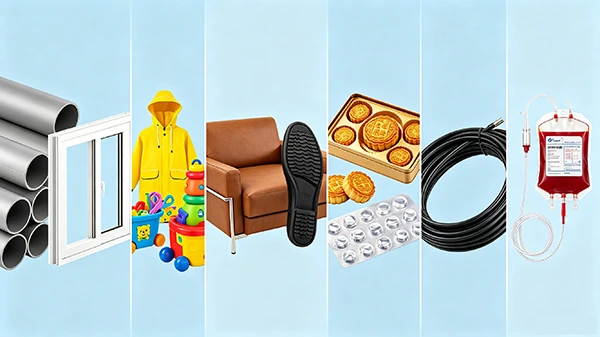
- Construction and Infrastructure Industry (The largest application field): PVC is an indispensable material in the construction industry, with about 70% of PVC consumption flowing into this field. Specific applications include: being manufactured through extrusion or hot pressing into water supply and drainage pipes, rainwater pipes and sewage pipes, window frames and door and window profiles, rigid plates, corrugated pipes and profiled pipes of various diameters, wire conduits or stair handrails, as well as various chemical corrosion-resistant storage tanks, air ducts, and containers.
- Soft Products and Calendered Film Field: After PVC raw material is mixed with additives and plasticized, it can be made into transparent or colored films of specified thickness using a calender (such as packaging bags, raincoats, tablecloths, curtains, inflatable toys, greenhouse agricultural films, and shrink packaging). In addition, it can be processed into hoses, high-grade sandals, shoe soles, slippers, toys, and automotive accessories through extrusion or injection molding.
- Coated Artificial Leather and Foamed Materials: Widely used in the manufacture of artificial leather (with or without substrate), utilized to make suitcases, leather bags, book covers, sofas, car seat cushions, and floor leather as flooring materials for buildings. When mixing, adding an appropriate amount of foaming agent can make foam plastics, used for foam slippers, insoles, shock-absorbing cushioning packaging, or extruded into low-foaming rigid PVC sheets to replace wood as a new type of building material.
- Transparent Sheets and Vacuum Blister Packaging: PVC mixed with impact modifiers and organotin stabilizers is blended, plasticized, and calendered into transparent sheets. By utilizing thermoforming, it can be made into thin-walled transparent containers or used for vacuum blister packaging (such as mooncake packaging boxes, pharmaceutical tablet blister packaging, and electronic product trays).
- Wire and Cable Industry: Flexible PVC is an ideal material for wire and cable insulation and sheathing, possessing good dielectric strength and flame retardancy. Typical applications in this field include: building wiring insulation, wire and cable sheathing, communication cables, optical fiber coverings, as well as insulation materials for electric vehicle charging cables and high-voltage cables.
- Medical Device Industry: PVC, by virtue of its good biocompatibility, transparency, and capability to be sterilized by ethylene oxide and gamma rays, has become the preferred material for disposable medical products. It is mainly used for: blood bags (blood collection and storage bags), infusion tubes (intravenous infusion lines), dialysis tubing, respiratory masks, oxygen masks, surgical gloves, and medical catheters.
Is Polyvinyl Chloride Recyclable?
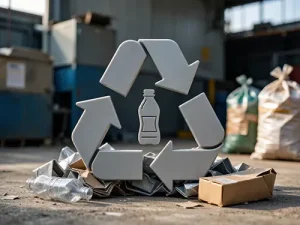
Yes, it can be recycled. PVC is a thermoplastic, which theoretically can be remolded multiple times by heating, therefore possessing the foundation for recycling and reuse. However, the current recycling rate of PVC is lower than that of some other general-purpose plastics, and a large portion of PVC waste is still sent to landfills or incineration. This is mainly because the high chlorine content of PVC makes it incompatible with many mainstream recycling processes, coupled with the fact that PVC contains a variety of additives (plasticizers, stabilizers, etc.), posing a huge challenge to the sorting and purification of the material. Nonetheless, significant progress has been made in PVC recycling technologies in recent years, mainly including the following three methods:
- Mechanical Recycling: This is currently the most mature method for PVC recycling. Clean PVC waste (such as door and window profile scrap, packaging waste, etc.) undergoes sorting, crushing, washing, drying, and melt re-granulation to be made into recycled PVC granules used for non-food-contact industrial products or architectural extrusion products. Usually, a certain proportion of virgin material is added to compensate for performance attenuation.
- Chemical Recycling: Mechanical recycling is difficult to handle PVC waste containing multiple impurities and composite structures, while chemical recycling technologies are iterating rapidly. For example:
- PVC Pyrolysis: Decomposes waste plastics into pyrolysis oil and combustible gas through oxygen-free high-temperature cracking, which can be used as chemical raw materials or fuel. However, the high-concentration hydrochloric acid gas generated by PVC requires specialized dechlorination pre-treatment.
- Solvent-based Recycling: Utilizing bio-based solvents successfully recycles rigid PVC waste, separating and recovering PVC, titanium dioxide (TiO₂), and calcium carbonate (CaCO₃) through a dissolution-precipitation method.
- Advanced Chemical Depolymerization: Adopting a low-temperature chemical recycling process specifically targeted at PVC, it converts PVC waste into sodium chloride solution and hydrocarbon oil equivalent to naphtha through dechlorination and catalytic cracking, which can be directly returned to chlor-alkali plants and steam crackers as raw materials, achieving a closed-loop cycle from PVC waste to new PVC raw materials.
- Energy Recovery: For mixed PVC waste that cannot be effectively recycled through mechanical or chemical means, its thermal value is recovered through controlled incineration for power generation or industrial heating, but it must be equipped with a comprehensive flue gas purification system to handle hydrogen chloride and dioxins.
Buy Polyvinyl Chloride
Choosing a reliable PVC resin supplier is vital to your production operations and long-term development. ZiJun Plastics, as a global quality supplier of resin raw materials and supply chain services, is dedicated to providing high-quality PVC resins and professional supply chain services for global customers.
Core Advantages of ZiJun Plastics:
- High-Quality and Stable Sources: Established long-term, stable, and close strategic partnerships with global mainstream petrochemical enterprises and well-known PVC resin manufacturers, ensuring that you are fully guaranteed in product quality, performance, and batch consistency.
- Strong and Stable Supply Guarantee: Relying on deep industry resources and a globalized supply chain network, we can continuously and stably supply goods to global customers. Even when facing drastic market fluctuations and tight raw material supply periods, we can still prioritize guaranteeing the order delivery for core customers.
- Highly Competitive Prices: By virtue of large-scale procurement advantages and efficient supply chain management capabilities, we are able to provide customers with market-competitive prices, helping you effectively reduce raw material procurement costs.
- Global Vision, Flexible Trade: Deeply understanding the complexity and regional differences of international trade, we can flexibly support various international trade settlement terms such as EXW (Ex Works), FOB (Free on Board), CIF (Cost, Insurance, and Freight), L/C (Letter of Credit), and T/T (Telegraphic Transfer) according to the specific needs of customers, providing customized trade solutions suitable for your business model.
- Customized Services: Recommend appropriate PVC grades (including extrusion grade, injection molding grade, blow molding grade, etc.) for you based on your product technical requirements, and provide customized material packaging options (ton bags, 25kg small bags, etc.).