Introduction
Polyoxymethylene (POM), also known as polyacetal, is a highly crystalline engineering thermoplastic polymerized from formaldehyde. Its balance of rigidity, dimensional stability, fatigue resistance, and self-lubricating properties has long made it a metal-replacement material in precision structural components, widely used in automotive transmission systems, electronic connectors, appliance gears, and industrial fasteners.
In 2026, the global POM market is estimated at approximately 1.9 million metric tons, with prices showing pronounced regional divergence: high-cost markets such as North America and Europe command clear premiums, while production regions such as Southeast Asia carry lower prices, and most regions posted mild gains in September. For buyers, understanding this structure of regional spreads and grade premiums has a more direct impact on procurement cost than simply asking whether prices will rise.
Global Price Levels and Regional Spreads
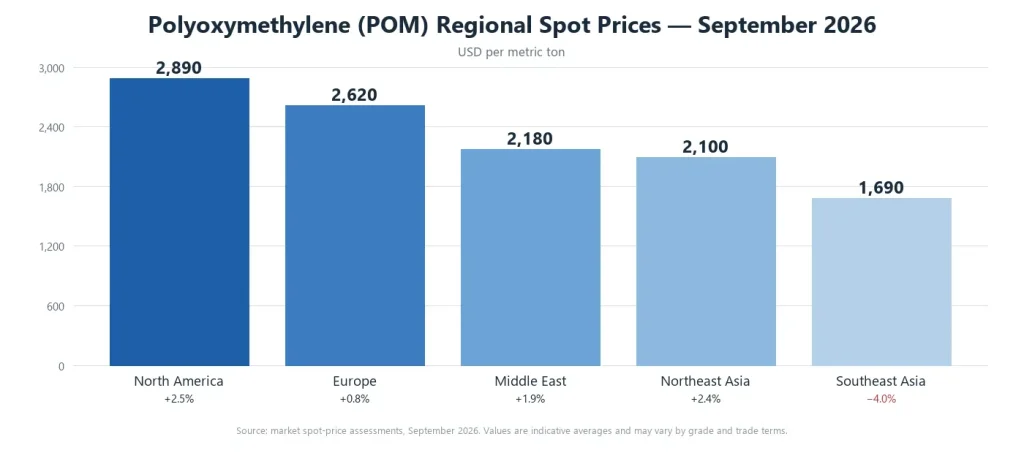
In September 2026, global polyacetal resin spot prices showed pronounced regional divergence:
| Region | Spot Average Price (USD/MT) | Month-over-Month |
|---|---|---|
| North America | ~2,890 | +2.5% |
| Europe | ~2,620 | +0.8% |
| Middle East | ~2,180 | +1.9% |
| Northeast Asia | ~2,100 | +2.4% |
| Southeast Asia | ~1,690 | −4.0% |
This structure reflects the core logic of POM pricing: a significant spread separates high-cost net-importing markets from production regions. North America carries the highest spot price and Southeast Asia the lowest, a gap exceeding USD 1,200/MT, with Europe, the Middle East, and Northeast Asia in between. This spread is more than enough to cover cross-regional logistics, warehousing, and distribution costs while still leaving room.
In terms of recent trends, most regions posted mild gains in September—North America (+2.5%), Northeast Asia (+2.4%), the Middle East (+1.9%), and Europe (+0.8%)—while Southeast Asia fell 4.0% month-over-month, indicating that supply-demand and cost rhythms are not synchronized across regions.
Price Drivers
POM prices are determined by three forces: cost, supply, and demand.
Cost side — methanol prices are the primary variable. The POM cost chain follows a “methanol → formaldehyde → polyoxymethylene” transmission path. As the core feedstock, methanol prices fluctuate with energy prices, operating rates, and seasonality, and these fluctuations transmit directly to POM costs. Some leading producers smooth out intermediate costs through vertically integrated “methanol–formaldehyde–POM–modified POM” layouts, making their list prices relatively more stable.
Supply side — Asia-Pacific capacity expansion caps the upside. As new capacity in Asia-Pacific comes online, generic grades are in ample supply and spot negotiations leave considerable room; supply of high-end copolymer grades and specialty modified grades remains more concentrated among producers with long-term process expertise, keeping their premiums firmer.
Demand side — automotive and electronics support structural demand. Automotive lightweighting and electronics miniaturization are the main drivers of POM demand growth, and also the directions where high-end grade premiums are most concentrated.
Downstream Demand Structure
POM demand is concentrated in five sectors:
| Application | Typical Components | Selection Focus |
|---|---|---|
| Automotive | Fuel-system peripheral parts, window-regulator and door-lock gears, wiper transmission gears, seatbelt mechanical parts | Fuel/oil resistance, wear resistance, thin-wall multi-cavity molding |
| Electrical & Electronics | Switch and socket structural parts, connector housings, relay and solenoid-valve parts | Low water absorption, dimensional accuracy, insulation performance |
| Home Appliances | Washing-machine/dishwasher internal parts, transmission gears, pump impellers, knobs | Synthetic-detergent resistance, hydrolysis resistance |
| Industrial Hardware | Precision fasteners, chain links, bushings, bearing cages | Self-lubricating, low friction, reduced maintenance |
| Consumer Goods | Lighter housings, aerosol valves, spray nozzles, zippers | Efficient molding, chemical stability |
Short-Term Outlook and B2B Procurement Strategy
Considering these three forces together, POM prices are expected to stay “regionally divergent with mild oscillation” for the remainder of 2026: generic grades in production regions are in ample supply with limited upside, while high-end copolymer and modified grades will find their premiums difficult to compress in the short term due to demand and supply thresholds.
Based on this, the following procurement recommendations are given (ordered by ease of action):
- Optimize sourcing by regional spread: With a spot spread exceeding USD 1,200/MT between North America and Southeast Asian production regions, buyers with stable volumes of generic grades should first evaluate the landed cost from production regions such as Southeast Asia and Northeast Asia (material price + freight + duties) rather than looking at a single quote.
- Procure generic grades in batches and trade volume for price: Use the current window of ample supply to place orders in batches, negotiating long-term contract pricing and payment terms.
- Verify batch-to-batch consistency for high-end grades first: For high-end copolymer or modified grades, request TDS, COA, and RoHS/REACH documents, and verify key indicators such as melt flow rate (MFR) and tensile strength, avoiding the sacrifice of batch stability in pursuit of substituting a higher-priced grade with a lower-priced one.
- Track methanol prices as a cost early-warning indicator: Methanol price trends can signal the short-term direction of POM costs and should be monitored continuously as a leading indicator in the procurement plan.
Additionally, the price trends of PA66, another engineering plastic, exhibit similar cost and supply logic and can be included in the same benchmarking review.
FAQ
Q1: How large are POM price differences across regions?
In September 2026, North America’s spot average was about USD 2,890/MT versus Southeast Asia’s roughly USD 1,690/MT, a spread exceeding USD 1,200/MT. This gap mainly reflects logistics, warehousing, and distribution cost differences between high-cost net-importing markets and production regions.
Q2: Are POM prices currently rising or falling?
The overall trend is mildly upward but regionally divergent. In September 2026, North America rose about 2.5% month-over-month, Northeast Asia about 2.4%, the Middle East about 1.9%, and Europe about 0.8%, while Southeast Asia fell 4.0%.
Q3: What are the core variables affecting POM prices?
On the cost side, methanol prices; on the supply side, the pace of Asia-Pacific capacity additions; on the demand side, the health of the automotive and electronics industries. Among these, methanol prices are the most direct and easiest to track.
Q4: How should buyers leverage regional spreads?
For generic grades, buyers should first evaluate the landed cost from production regions such as Southeast Asia and Northeast Asia; for high-end grades, given their grade systems and certification thresholds, batch-to-batch consistency and compliance documentation matter more than price alone, and buyers should not simply chase the lowest quote.