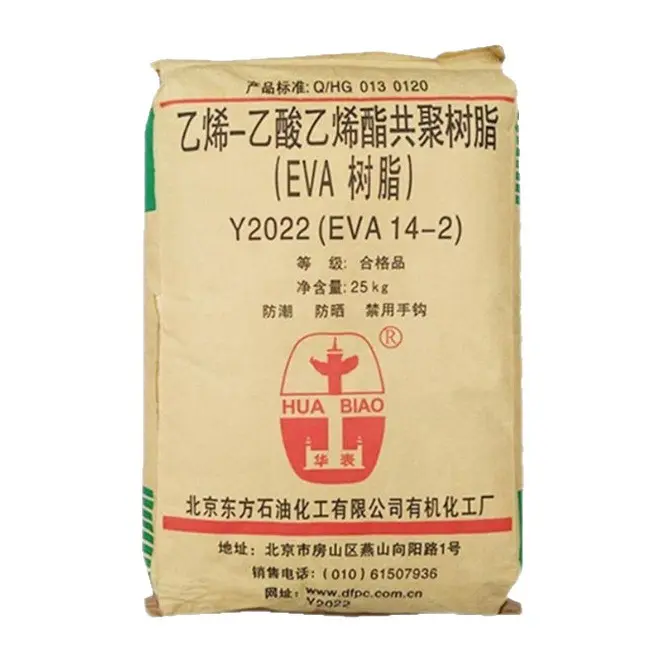
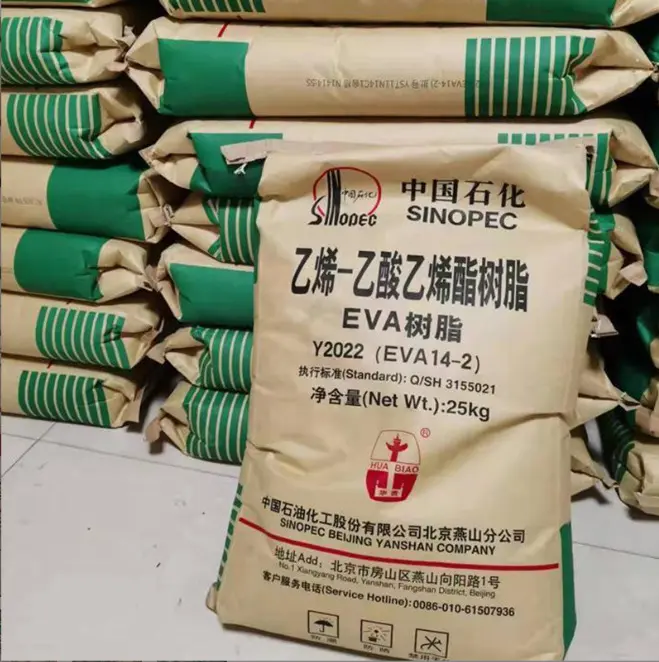
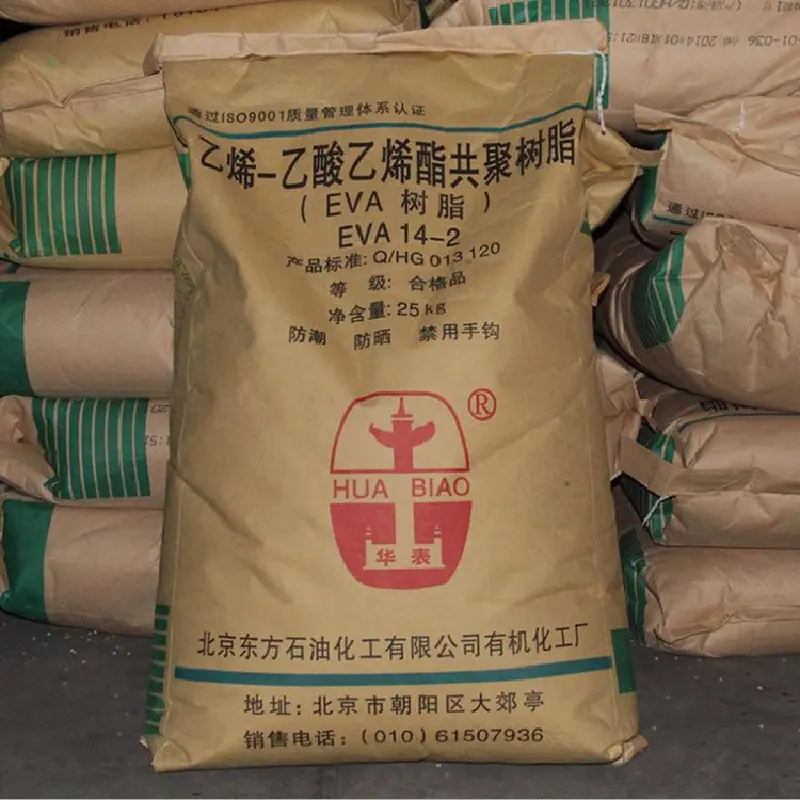
Beijing Organic Chemical Factory EVA Y2022 (14-2) film-grade copolymer resin features 14% VA content, high transparency, and excellent elongation, making it ideal for packaging and photovoltaic applications.
| Manufacturer | Beijing Organic Chemical Factory |
|---|---|
| Density | 0.935 g/cm³ |
| MFR | 2 g/10 min |
| Melting Point | 95 ℃ |
| Vicat Softening Point | 70 ℃ |
Note: See the product description for additional technical specifications
Manufacturer: Beijing Organic Chemical Factory
Material Category: EVA (Ethylene-Vinyl Acetate Copolymer, Film Grade, 14% VA Content)
Physical Appearance: High-transparency film rolls with a smooth surface, low haze, and excellent light transmission performance.
EVA Y2022 (14-2) is a film-grade ethylene-vinyl acetate copolymer produced by Beijing Organic Chemical Factory, featuring a vinyl acetate (VA) content of 14% and a melt index of 2 g/10min. This film grade exhibits high elongation, favorable flexibility, and optical performance, alongside stable electrical insulation properties. In the category of EVA film materials in China, this grade features stable performance parameters and good batch consistency. It is widely used in applications such as packaging, photovoltaic auxiliary materials, insulation films, and composite films, and is compatible with mainstream processing methods like film extrusion and lamination, making it a commonly used EVA base material in the film manufacturing industry.
| Property | Test Condition | Value | Unit | Test Method |
| Melt Flow Rate (MFR) | — | 2 | g/10 min | ASTM D1238 |
| Thickness | — | 40 | µm | Internal Method |
| Density | — | 0.935 | g/cm³ | ASTM D1505 |
| Vinyl Acetate Content | — | 14 | % | ISO 8985 |
| Property | Test Condition | Value | Unit | Test Method |
| Tensile Yield Strength | Transverse | 4.1 | N/mm² | ASTM D638 |
| Tensile Yield Strength | Machine Direction | 4.5 | N/mm² | ASTM D638 |
| Tensile Strength at Break | Transverse | 24 | N/mm² | ASTM D638 |
| Tensile Strength at Break | Machine Direction | 24 | N/mm² | ASTM D638 |
| Secant Modulus | Machine Direction, 1% Elongation | 44 | N/mm² | ASTM D882B |
| Secant Modulus | Transverse, 1% Elongation | 50 | N/mm² | ASTM D882B |
| Elongation at Break | Transverse | 720 | % | ASTM D638 |
| Elongation at Break | Machine Direction | 440 | % | ASTM D638 |
| Shore Hardness | D | 33 | — | ASTM D2240 |
| Shore Hardness | A | 92 | — | ASTM D2240 |
| Tear Strength | Transverse | 129 | g | ASTM D1922 |
| Tear Strength | Machine Direction | 91 | g | ASTM D1922 |
| Property | Test Condition | Value | Unit | Test Method |
| Melting Point | — | 95 | ℃ | Internal Method |
| Vicat Softening Point | — | 70 | ℃ | ASTM D1525 |
| Property | Test Condition | Value | Unit | Test Method |
| Dielectric Strength | — | 670 | kV/cm | ASTM D149 |
| Dielectric Constant | 2×10⁶ Hz | 2.9 | — | ASTM D150 |
| Property | Test Condition | Value | Unit | Test Method |
| Haze | — | 1.9 | % | ASTM D2457 |
| Gloss | — | 82 | % | ASTM D1003A |
The technical data sheet (TDS) of EVA Y2022 (14-2) material from Beijing Organic Chemical Factory corporation; if there are discrepancies, please refer to the official website of Beijing Organic Chemical Factory.
Outstanding Optical Performance: Features a film haze of only 1.9% and a gloss of 82%, offering good transparency suitable for film products requiring high visibility.
High Ductility and Flexibility: Transverse elongation at break reaches up to 720%, allowing the material to withstand substantial stretching deformation with strong bending resistance and low brittleness.
Balanced Tear Performance: Stable transverse and tear strength in both directions, providing good resistance to tearing damage during processing and application.
Reliable Electrical Insulation Characteristics: Dielectric strength of 670 kV/cm and a stable dielectric constant, making it suitable for low-voltage insulating film applications.
Stable Thermal Processing Window: Melting point of 95°C and Vicat softening point of 70°C, providing a controllable processing temperature range compatible with film production processes such as extrusion lamination.
Packaging Film Industry: Inner base materials for flexible food packaging and composite packaging; relies on high transparency and high elongation to suit packaging heat-sealing and folding scenarios.
Photovoltaic Auxiliary Materials: Can be used as a substrate film for photovoltaic module encapsulation; relies on good light transmission and flexibility to suit lamination processes.
Electrical Insulation Films: Insulating protective films for low-voltage electronic components; utilizes stable dielectric properties to provide isolation and protection.
Composite Protective Films: Surface protective films for metal sheets and plastic sheets; balances transparency and tensile properties for easy lamination and peeling.
Daily Elastic Films: Elastic stretch films and sealing films suitable for products requiring repeated deformation and flexible wrapping.
Q1: Is drying treatment necessary before processing EVA Y2022 (14-2)?
A1: As a film-grade EVA product, it exhibits low moisture absorption under normal storage conditions. If storage humidity is relatively high, moisture content testing is recommended in advance. If moisture content exceeds the limit, low-temperature drying can be performed to prevent bubbles and surface defects during processing.
Q2: What are the main selection differences between 14% VA EVA and low VA content EVA?
A2: Higher vinyl acetate content results in better EVA flexibility, transparency, and adhesion, though rigidity decreases. With a 14% VA content, Y2022 (14-2) is softer and offers better light transmission than low-VA grades. Low-VA EVA provides higher rigidity and better temperature resistance, making it suitable for scenarios requiring greater structural strength.
Q3: Is export supported for this EVA film, and can compliance documents be provided?
A3: Foreign trade export is supported. TDS, MSDS, and batch-specific COA quality inspection reports can be provided. The material meets basic environmental compliance requirements such as RoHS and REACH, and can be used for overseas customer factory audits and product declarations.
Q4: Is this film suitable for use under long-term high-temperature conditions?
A4: With a Vicat softening point of 70°C, this material is not suitable for long-term continuous high-temperature environments exceeding 70°C, as softening and deformation will occur. The continuous operating temperature of the end product must be verified during material selection.
Submit your inquiry today and receive a professional competitive price tailored to your project requirements.