
Global PMMA Market Overview and Scale
Polymethyl Methacrylate (PMMA), commonly known as acrylic, is a thermoplastic transparent polymer synthesized via the polymerization of Methyl Methacrylate (MMA) monomers. Renowned for its exceptional optical clarity, high surface hardness, outstanding weatherability, and dimensional stability, PMMA holds an irreplaceable and vital position in sectors such as automotive lighting, architectural glazing, electronic displays, medical devices, and advertising fixtures. Among transparent plastics, its light transmittance can exceed 92%, outperforming Polycarbonate (PC, 86%-89%) and Polystyrene (PS), while offering a glass-like gloss at a fraction of the weight.
In terms of global market volume, industry reports indicate that the global PMMA market size is projected to reach 3.21 million metric tons in 2026, up from 3.06 million metric tons in 2025, and is expected to expand further to 4.08 million metric tons by 2031, representing a Compound Annual Growth Rate (CAGR) of approximately 4.90%. From a value perspective, the global PMMA market was valued at approximately USD 6.66 billion in 2025 and is anticipated to grow to USD 7.27 billion in 2026, exhibiting a robust CAGR of up to 9.2%.
Regarding regional supply and demand dynamics, the Asia-Pacific region, particularly China, serves as the world’s largest production and consumption hub for PMMA. Structural overcapacity within this region keeps global PMMA prices highly competitive. By the end of 2025, domestic PMMA capacity in China had surpassed 850,000 metric tons, making it one of the most capable supply regions globally. Concurrently, traditional European and American markets are undergoing structural adjustments, while new capacities in the Middle East and the United States are being progressively released, reshaping the global trade landscape.
Data Source Note: The industry data and pricing information cited in this article are primarily sourced from public reports and market analyses published by professional institutions, including IMARC Group, Mordor Intelligence, Sci99 (Zhuoch), OilChem, JLC, and S&P Global, and are intended for industry reference only.
Comparison of Spot PMMA Prices Across Major Global Regions (March 2026)
According to the global PMMA pricing data for March 2026 published by IMARC Group, spot prices exhibited notable divergence across different regions due to variances in supply-demand structures, logistics costs, and trade flows:
| Region | Price (USD/KG) | Price (Approx. RMB/Ton) | MoM Change |
| Northeast Asia | 2.29 | ≈ 16,600 | -1.3% ↓ |
| Southeast Asia | 3.11 | ≈ 22,500 | +3.0% ↑ |
| North America | 3.48 | ≈ 25,200 | -1.1% ↓ |
| Europe | 3.83 | ≈ 27,700 | -3.0% ↓ |
The operational characteristics and core drivers for each regional market are analyzed as follows:
- Northeast Asia: Standing at approximately 2.29 USD/KG, Northeast Asia represents the lowest price point among the listed regions. The region houses multiple state-of-the-art PMMA production units, creating intense local supply competition. Meanwhile, demand growth from the downstream automotive and electronics manufacturing sectors remained stable, with procurement dominated by rigid, small-volume orders, collectively dampening any upward price momentum.
- Southeast Asia: The PMMA price in Southeast Asia hovered around 3.11 USD/KG, gaining 3.0% month-on-month, making it the only major regional market to log a monthly increase. Robust expansions in the automotive, electronics, and consumer goods sectors—particularly in Thailand, Malaysia, and Vietnam—fueled strong demand for PMMA. However, limited local production capacities coupled with cost pressures from a heavy reliance on imported MMA feedstocks left regional prices highly sensitive to upward trends.
- North America: PMMA prices in North America softened slightly to around 3.48 USD/KG. Demand across the automotive, electronics, and construction fields remained generally steady, regional production facilities operated normally, and logistics costs showed no abnormal volatility.
- Europe: Europe posted the highest price premium at approximately 3.83 USD/KG, despite booking a month-on-month decline of 3.0%. Environmental compliance expenses (such as the EU REACH regulation) alongside elevated energy costs continued to inflate manufacturing margins, while persistent pressure from low-priced imports from the Middle East kept European prices heavy amid supply-demand negotiations.
From a price spread perspective, a clear regional pricing gradient is evident: European PMMA prices were roughly 65% higher than those in Northeast Asia, 23% higher than Southeast Asia, and 10% higher than North America. This pronounced arbitrage structure theoretically opens up trade windows; however, because actual arbitrage margins open and close dynamically based on ocean freight rates and evolving trade policies, trade flows are constantly being realigned.
The Chinese PMMA Market: Price Trends, Spread Structures, and Core Drivers
As the world’s leading PMMA production and consumption marketplace, price fluctuations in China carry substantial weight for the global industry.
Review of Overall Price Trends
Throughout 2025, the Chinese PMMA market moved along a downward trajectory. A downward shift in upstream MMA costs initially boosted theoretical profitability for the PMMA sector. Driven by these lucrative margins, industry operating rates accelerated, which, paired with sluggish downstream demand, intensified the supply-demand mismatch. As a result, PMMA prices entered a downward channel, causing sector profitability to erode rapidly.
Moving into the first quarter of 2026, under the dual impact of volatile crude oil benchmarks and geopolitical tensions in the Middle East, the chemical commodities market witnessed a broad rally. The Chinese PMMA market mirrored this trend with sharp gains, experiencing a highly volatile “surge-and-drop” pattern within the quarter.
Specifically:
- January to Mid-to-Late February: Trading activity was muted around the Lunar New Year holiday, keeping PMMA prices at low baselines. As of February 28, market discussions settled within a reference range of approximately RMB 10,500 – 13,400/ton.
- Late February to Mid-March: As raw MMA costs escalated swiftly, cost-pass-through effects trickled down completely. PMMA values began climbing in early March, and by late March, spot prices broke through to new highs of around RMB 19,000/ton.
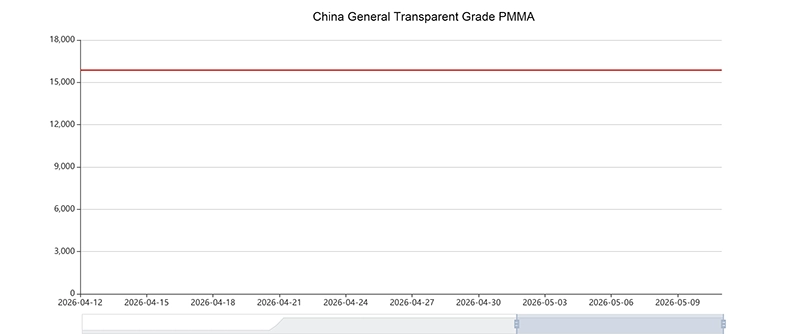
- Late March to Mid-April: Entering April, raw MMA costs registered a notable correction, weakening the cost support for PMMA. During the mid-April weekly cycle, the primary trading range for China’s PMMA pellet market retraced to around RMB 15,500 – 19,800/ton, with the high-to-low price spread widening. Simultaneously, pellet plant capacity utilization dropped by roughly 3 percentage points to 54%, driving downstream sentiment toward a cautious stance focused on hand-to-mouth procurement.
Core Factors Driving Price Operations
The direct variables dictating PMMA price shifts can be categorized into three main fronts:
- The Cost-Pass-Through Mechanism of Upstream MMA MMA is the essential upstream monomer for PMMA, accounting for a major portion of overall PMMA manufacturing costs. Consequently, every sharp fluctuation in MMA values acts directly on PMMA pricing through cost transmission.
- The 2025 Trend: In 2025, MMA costs generally weakened, with the annual average price in East China dropping by roughly 25.91% year-on-year, touching multi-year lows. While lower feedstock costs expanded theoretical profit margins for PMMA producers, it triggered higher operating rates and rising supply rollouts, ultimately depressing PMMA market values in the absence of matching demand growth.
- The Q1 2026 Turnaround: Entering 2026, the MMA market reversed into a fierce rally. Average MMA prices gained 1.52% month-on-month in February and surged by 39.71% in March, driven by spiking energy benchmarks. Rocketing feedstock values pushed PMMA prices sharply upward, with China’s average PMMA price jumping 37.89% month-on-month in March. However, the velocity of this price spike outpaced what downstream buyers could absorb, resulting in quiet spot volumes and a cautious, hand-to-mouth purchasing pattern.
- By mid-to-late April, delivered MMA prices in South China dropped over 11% year-on-year. Consequently, cost support for PMMA contracted, causing spot values to signal a retreat.
- Supply-Side Dynamics Supply variables similarly dictate pricing logic within the Chinese PMMA arena. On the capacity front, domestic PMMA capacity in China surpassed 850,000 metric tons by the end of 2025. In terms of operating metrics, the PMMA industry saw some upside room in plant loads since 2025 (touching 61% in certain months), but utilization retraced to around 54% by April 2026. Furthermore, shifts in import structures deserve close attention. High-end import PMMA grades retain a fixed market share due to quality and performance advantages that domestic alternatives cannot yet fully replace. Additionally, the continuous rollout of select new capacities places a ceiling on any long-term price rebounds.
- Demand-Side Dynamics Downstream demand for PMMA in China spans automotive components, electrical appliances, building materials, and advertising displays. Broadly speaking, downstream demand growth has been slow since 2025, heavily influenced by the macroeconomic climate and sector-specific lifecycles:
- Construction: Real estate regulations led to fewer new construction starts, cooling demand for PMMA architectural products (e.g., skylights, shower enclosures).
- Automotive: Although China’s automotive production and sales volumes lead globally, the expansion rate of PMMA applications in interior and exterior trims remained relatively modest.
- Electronics/Appliances: Fierce competition and fast product cycles failed to generate a significant surge in PMMA consumption.
- Advertising Signage: Under the impact of digital media, traditional demand for acrylic sheets in advertising lightboxes continued to contract. In 2026, despite the cost-driven spike in PMMA prices, downstream tolerance for high-priced raw materials remained low. Procurement trended highly conservative, dampening overall market liquidity. This dynamic of “cost-driven price increases met by demand-capped price ceilings” forms the defining feature of the current PMMA market.
Global PMMA Pricing Systems and Cost Transmission
Cost Transmission Mechanisms
PMMA pricing shares a high correlation with MMA values, though they do not move in perfect lockstep. Upstream MMA tracks the volatility of crude oil, propylene, and acetone benchmarks closely, causing frequent price adjustments. While sharp MMA swings quickly filter down to the PMMA segment, downstream absorption capacities and buying appetite act as a “damping” mechanism. This buffer slows down PMMA price gains during upward rallies but also lends a degree of downside resistance during market corrections.
Additionally, the steady release of new domestic capacities in China sustains localized supply pressures, anchoring domestic PMMA prices at globally competitive baselines and cementing Northeast Asia’s status as a global price vacuum.
Key Variables to Watch
The following critical factors will continue to steer PMMA price trends in the short to medium term:
- Upstream MMA Pricing Directives: In the short run, MMA movements remain the primary driver for PMMA pricing. If energy benchmarks hold firm, MMA will retain strong cost support, potentially lifting the PMMA price floor. Conversely, any pullback in MMA will strip PMMA of its cost backing, introducing downside vulnerabilities.
- The Pace of Global Capacity Rollouts: New capacity additions from the Middle East and the United States are set to ease global PMMA supply balances further. Rohm’s new 250,000 metric ton/year production line in Texas, USA, reached a 75% utilization rate in November 2025, with a target to hit full nameplate capacity in the first quarter of 2026. Looking ahead, US MMA export volumes are projected to grow at a steady CAGR of 3.46% over the next five years.
- Downstream Demand Recovery Timelines: While structural trends like automotive lightweighting, electric vehicle lighting systems, and optical display technologies maintain demand for PMMA, it will take time for these applications to translate into a volume expansion substantial enough to offset supply gains.
Conclusion
In summary, the global PMMA market is moving through a critical evolutionary phase defined by the intersection of demand constraints and cost-push dynamics. Northeast Asia leverages its highly efficient supply chains and immense capacity footprints to maintain a distinct price advantage, while Europe and North America operate within higher premium bands, sustaining visible regional price spreads that continue to yield trade opportunities.
For global market participants across the upstream and downstream PMMA value chains, mapping out key cost transmission thresholds and aligning with shifts in demand lifecycles will prove vital to forming sound procurement strategies in a volatile market environment.